AI revenue systems · 13 min read
AI lead scoring for B2B: a practical revenue framework
B2B AI lead scoring should do more than rank names in a CRM. A useful system combines account fit, current intent and operational safeguards to select the next action, then learns from outcomes that sales records consistently.
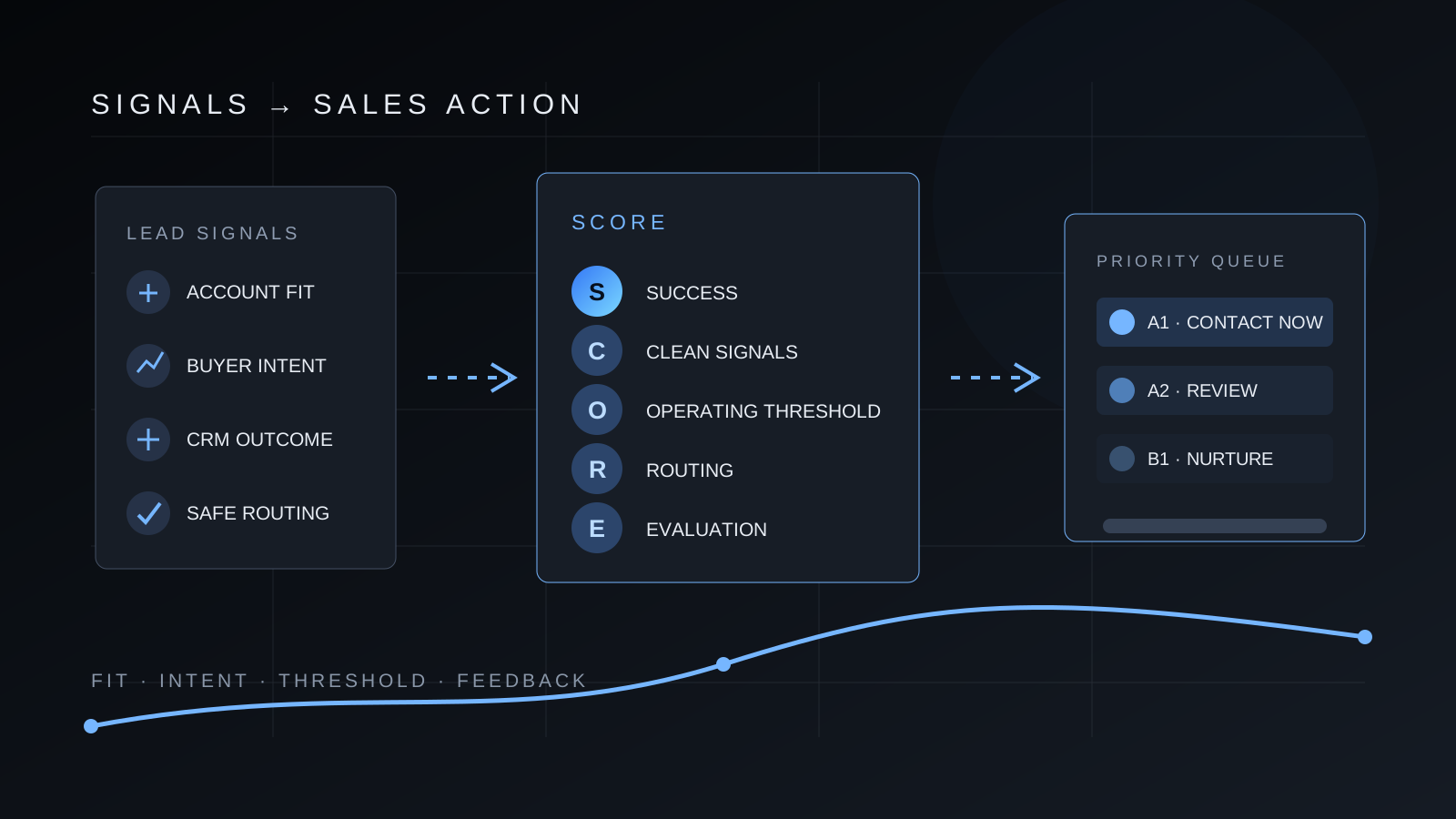
The direct answer: a lead score must drive an action
AI lead scoring uses account, contact and behavioural data to estimate which lead is closer to a defined commercial outcome. The output should not stop at a number from 0 to 100. It should tell the operating team whether to contact the lead now, place it in nurture, request missing information or remove it from the active queue.
The most common failure is building a model before defining success. A label that mixes form submissions, booked meetings and closed deals gives the model an ambiguous target. Start with one observable funnel transition, a time window and a reliable feedback loop from the CRM.
NUMEDIA recommends a staged path: transparent fit and intent rules first, controlled routing second, and predictive modelling only after the business has enough trustworthy examples. AI improves an operating system. It does not repair inconsistent definitions, broken identity data or missing sales outcomes.
Keep fit, intent and operational readiness separate
Fit asks whether the account can realistically benefit from the offer. Relevant inputs may include industry, size, market, business model and technology. Intent or engagement describes current behaviour, such as viewing pricing, returning to a use case, responding to outreach, requesting a demo or booking a call.
Do not hide both dimensions inside one unexplained score. A strong-fit account with low intent needs a different action from a highly active visitor outside the target market. HubSpot's current documentation similarly distinguishes fit, engagement and combined scores and makes those properties available to segments, workflows and reports.
Operational readiness is a third layer. A promising lead still should not be routed automatically when the account owner is missing, the record is a duplicate, an opportunity is already open or a required exclusion applies. These conditions are workflow gates, not predictive features.
| Layer | Question | Example signal | Typical action |
|---|---|---|---|
| Fit | Can this account gain value from the offer? | Industry, size, market, technology | High fit enters targeted sales coverage |
| Intent | Is interest increasing now? | Pricing visit, return visit, demo request | High intent shortens response time |
| Operations | Can the next action run safely? | Owner, duplicate, open opportunity | Block, merge or request human review |
The SCORE framework: five decisions from outcome to improvement
S is Success outcome. Choose one explicit result, such as a sales-qualified meeting within 30 days or a created opportunity within 60 days. Define the negative cases too. This prevents the system from confusing fast activity with commercial quality.
C is Clean signals. Document sources, owners, timestamps, missing values and target leakage. A field created after qualification cannot be used to predict qualification. Historical examples must reflect the information that was available at decision time, not values added later.
O is Operating threshold. Select the threshold around sales capacity and the cost of mistakes. A team with scarce selling time may prioritise precision. A business where a missed opportunity is more costly than an additional review may choose higher recall. A default threshold of 0.5 is not a commercial policy.
R is Routing and reasons. Connect the result to an owner, response window, sequence and a short explanation of the leading signals. Sales should know why the lead moved up and what to do next. Allow a manual override with a reason that the team can analyse later.
E is Evaluation and evolution. Track data health, precision, recall, calibration, commercial outcomes and sales adoption. Give thresholds and models a version, a change date and an owner. Improve the system from completed outcomes, not from the assumption that more points always mean more value.
Start with a data contract, not a long feature list
For every input, document its meaning, system of record, owner, event time, allowed values and treatment of missing data. CRM, analytics, marketing automation and product systems often use different identifiers. Without a stable link between contact, account and opportunity, the model sees fragments rather than a customer journey.
Evaluate signals on three criteria: availability before the decision, stability and explainability. Email opens may be less dependable than a booked meeting. Self-reported company size is useful only when categories stay consistent. Page visits become meaningful when you distinguish incidental traffic from high-intent content.
Google's production ML guidance recommends input schemas, tests for feature transformations and monitoring for unexpected values and distributions. In lead scoring, that means alerting when a critical source stops sending events, industry suddenly becomes missing for a large share of records or a new campaign changes the lead mix.
- The target label has one meaning across marketing, sales and the CRM.
- Every feature has a source, owner, event time and allowed values.
- Information created after the target event is excluded from prediction.
- Contact, account and opportunity identities can be reconciled.
- A missing value is not automatically treated as poor fit.
- Sensitive or commercially irrelevant data is excluded.
- The pipeline detects missing events, schema changes and distribution shifts.
Choose thresholds from the cost of a wrong decision
Lead scoring usually involves an uncommon positive outcome. Accuracy alone can therefore mislead: a model that marks almost every lead as unqualified may look accurate while being useless. Precision asks what share of prioritised leads was truly positive. Recall asks what share of all positive leads the system found.
The scikit-learn documentation shows how changing the decision threshold moves the operating point between precision and recall. Select that point with sales. A call-now queue may need high precision. An automated nurture stream can accept a lower threshold because the marginal cost of including one more lead is smaller.
If the score is presented as a probability, test calibration too. A score of 0.8 can be interpreted as an 80% estimate only when similarly scored leads convert at roughly that rate. A model can rank leads well and still be overconfident, so calibration is a separate requirement from ordering.
| Measure | Question answered | Why it matters |
|---|---|---|
| Precision | How many prioritised leads were genuinely qualified? | Protects selling time and queue quality |
| Recall | How many qualified leads did the system find? | Reveals missed opportunities |
| Calibration | Do predicted probabilities match observed outcomes? | Supports thresholds and capacity planning |
| Lift by band | Does the top band beat the baseline outcome rate? | Shows the value of ranking |
| Time to first response | Did routing make the operation faster? | Connects the model to execution |
| Sales adoption | Do reps use and meaningfully override the score? | Exposes the gap between model and workflow |
Write the score, band, reasons and version back to the CRM
Do not store only the final number. Keep separate fit and engagement scores, the operating band, calculation time, rule or model version and a few understandable reason codes. The seller can inspect the context, while the analyst can reproduce a decision later.
Salesforce Einstein Lead Scoring is one production example of using lead fields to generate prioritisation insight. HubSpot exposes score properties to lists, workflows and reporting. The platform is secondary to the operating principle: the score becomes useful only when it triggers a consistent next step and the resulting sales outcome returns to the same system.
Set service levels by score band, but keep safeguards visible. A newly created high-score lead might open a task and alert rather than send a personalised message without review. Duplicate records, existing customers, open opportunities and explicit exclusions must stop or redirect automation.
Monitor the model by segment and over time
An aggregate metric can hide weak performance in an important industry, region, source or account size. Google's production monitoring guidance specifically recommends evaluating important data slices. For a B2B model, compare priority markets, acquisition channels, sales teams and the major offer segments.
Separate technical from business monitoring. Technical controls detect missing signals, distribution shifts, model age and training-serving skew. Business controls track qualified meetings, created opportunities, response time, sales adoption and downstream results by score band.
Run a controlled introduction. Keep a portion of leads on the previous process or display the score as a recommendation before automating routing. That reveals whether the system improves prioritisation and execution rather than merely explaining historical CRM data.
A 30-day path from rules to safe automation
In week one, align the outcome, time window, exclusions and baseline success rate. Audit CRM stages and decide which outcome is dependable enough for learning and reporting. If teams use the same stage differently, fix that process before modelling.
In week two, build the data contract, reconcile identities and create a transparent rule-based score. Keep fit and intent separate. On historical data, test whether the top bands contain more target outcomes and confirm that no feature leaks information created after the sales decision.
In week three, display the score in the CRM and pilot it with one team or segment. Set a capacity-aware threshold, owner, response window, safeguards and an override workflow. Capture the reason whenever sales rejects the recommendation.
In week four, compare precision, recall, lift, response time and adoption. Only then decide whether prediction adds value. When data is still limited, disciplined rules with a reliable feedback loop outperform a complex AI score trained on an unstable target.
Sources and methodology
- Overview of the lead scoring tool (HubSpot Knowledge Base, accessed 2 October 2026)
- Einstein Lead Scoring for Account Engagement (Salesforce Help, accessed 2 October 2026)
- Production ML systems: Monitoring pipelines (Google for Developers, accessed 2 October 2026)
- Precision-Recall (scikit-learn, accessed 2 October 2026)
- Probability calibration of classifiers (scikit-learn, accessed 2 October 2026)
Frequently asked questions
What is AI lead scoring?
AI lead scoring estimates the likelihood of a defined sales outcome from fit, behaviour and historical outcomes. A production system connects the score to a clear next action and a feedback loop in the CRM.
How much data do we need for predictive lead scoring?
There is no universal count. You need enough reliable positive and negative examples for the chosen outcome, stable features and a separate validation set. If those are missing, start with transparent rules and collect better outcomes.
What is the difference between fit and engagement scoring?
Fit measures whether the account matches the offer. Engagement measures current interest and behaviour. Keeping both visible supports different actions for a strong-fit account with low intent and an active contact with poor fit.
Which metric matters most for lead scoring?
It depends on the cost of errors. Precision protects sales time, recall reduces missed opportunities, and calibration tests whether probabilities mean what they claim. Always include commercial measures such as response time, qualified meetings and opportunities.
Should AI automatically contact every high-scoring lead?
Not without workflow gates. Check ownership, duplicates, open opportunities, exclusions and the appropriate channel first. For high-value or sensitive interactions, use the score to create a human task.
How often should the model be updated?
Monitor data and outcomes continuously, and review thresholds after material changes to offers, channels or the sales process. Retrain when measured deterioration or enough new outcomes justify it, not merely because a calendar date arrived.