Performance measurement · 12 min read
Server-side tracking for ecommerce: a measurement blueprint that survives the real world
Server-side tracking can make ecommerce measurement more controlled and resilient, but only when the order model, identifiers and validation rules are correct first. This blueprint starts with the commercial event and treats each advertising platform as a destination, not the source of truth.
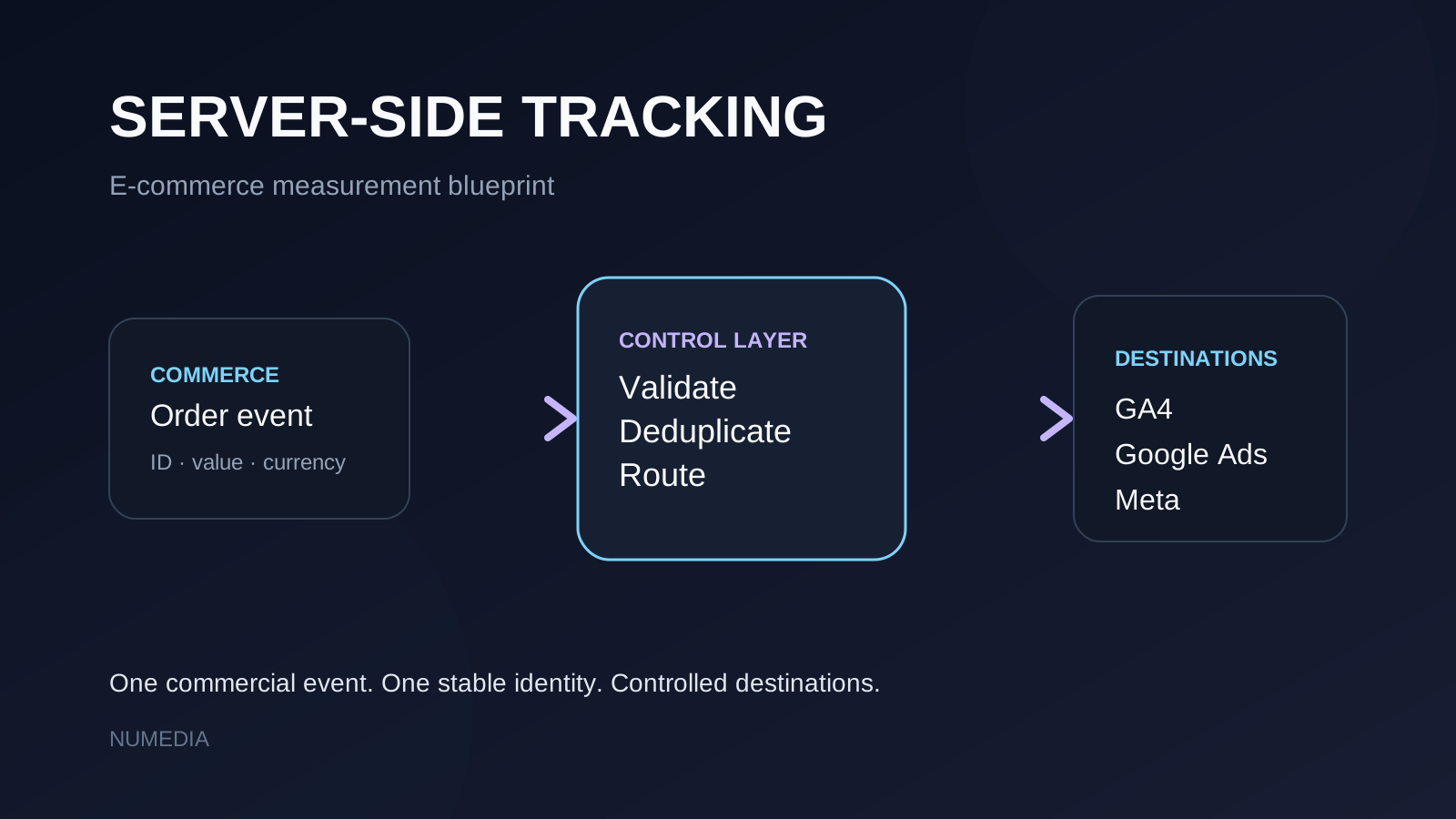
The direct answer: server-side tracking is a control layer, not a repair button
Server-side tracking routes selected measurement events through infrastructure controlled by the business before sending them to analytics and advertising platforms. A sound implementation can improve data quality, control over payloads and measurement resilience. It cannot rescue an incorrectly defined purchase, inconsistent currency rules, duplicate orders or a broken consent setup.
The best architecture is therefore not the one with the most tags. It is the shortest auditable path from a real commercial event to a trusted record: one event, one stable identifier, a defined value, known consent state, an explicit purpose and controlled destinations. NUMEDIA uses the SIGNAL framework to design that path: Source, Identity, Governance, Accuracy, Navigation and Ledger.
For most ecommerce businesses, a hybrid setup is practical. The browser captures session context and product behaviour, while the server confirms commercially important outcomes such as a completed purchase, refund or qualified lead. Both paths must share the identifiers required by each platform to recognise two copies as one event.
Why ecommerce measurement breaks
The problem usually appears as a gap between orders in the store backend, GA4, Google Ads and Meta Ads. Perfect agreement is not the goal because attribution rules, time windows and modelling differ. Large or sudden gaps, however, often reveal an implementation fault: purchase firing again when the confirmation page reloads, a missing transaction_id, the wrong currency, an event sent before payment is confirmed, a blocked browser request or mismatched identifiers between Pixel and Conversions API.
Google's GA4 documentation states that ecommerce events are not collected automatically because they need additional context. The store must implement the events, parameters and item data. A server layer can then improve transport and control. If the source model is poor, server-side delivery simply distributes a poor event more efficiently.
| Symptom | Likely cause | First check |
|---|---|---|
| GA4 reports more purchases than the backend | Purchase fires twice or transaction_id is empty | Compare unique order IDs |
| Meta shows duplicate events | Browser and server copies do not share event_id | Inspect the deduplication key and timestamp |
| Revenue is too low | Value, currency or items are missing | Compare the payload with the backend order |
| Google Ads sees too few conversions | Tag, consent, matching or import issue | Review diagnostics and a test purchase |
| Every system is far apart | Different confirmation points and attribution | Define the commercial source of truth first |
The SIGNAL framework
Source defines the authoritative system. For an order, this is usually the ecommerce backend or payment workflow after a documented business state, not the thank-you page by itself. Analytics explains behaviour and ad platforms assign credit. Neither should silently become the accounting record.
Identity connects the copies of an event. Every purchase needs a unique transaction_id. A purchase sent from both browser and server needs the shared deduplication identifier prescribed by the destination. GA4 uses transaction_id to deduplicate web purchase events. Google Ads also requires a unique dynamic ID and warns that reused or static values can create material undercounting.
Governance documents the purpose, source, allowed destinations, retention and owner of every field. Server-side tracking does not remove consent obligations or platform rules. Legal requirements depend on markets, technology and actual data use, so the configuration requires appropriate legal review.
Accuracy gives every monetary field one definition. Value, currency, tax, shipping, discounts and product items must reconcile to the agreed order state. Comparing gross revenue in one tool with net revenue in another creates a reporting problem that no attribution model can solve.
Navigation maps the path from store to collection layer and onwards to GA4, Google Ads or Meta. Each hop needs schema validation, an allowlist of fields and predictable error handling.
Ledger records versions, test orders, expected payloads, consent changes and container releases. When performance moves, the team can distinguish a commercial change from a tracking release.
A target architecture for GA4, Google Ads and Meta
Layer one is the commerce platform. It produces structured events for view_item, add_to_cart, begin_checkout and purchase. Purchase is created only when the agreed order state is reached. Monetary values come from the commerce system rather than scraped interface text.
Layer two is the web container or direct client implementation. It captures session context and, under the applicable consent state, sends the permitted event to a first-party collection domain. Google's production guidance recommends a first-party domain for the server container.
Layer three is the server container or application endpoint. It validates the schema, removes fields that should not travel, adds legitimate server-known context and sends approved payloads to each destination. Meta Pixel and Conversions API copies use a common event_id for deduplication. Google purchase flows use a consistent transaction_id where specified.
Layer four is reconciliation. Daily monitoring checks more than total conversions. It measures the proportion of events with a valid ID, currency, value, item data, timestamp, consent state and destination response. That reveals a tracking failure before it changes budget decisions.
| Event | Primary source | Required commercial context | Control |
|---|---|---|---|
| view_item | Product page | item_id, item_name, price, currency | Product ID exists in the catalogue |
| add_to_cart | Cart or application | items, quantity, value, currency | Value reconciles to item rows |
| begin_checkout | Checkout start | items, value, currency, coupon | Does not fire on a simple cart view |
| purchase | Backend after confirmation | transaction_id, value, currency, tax, shipping, items | ID is unique and revenue matches the order |
| refund | Backend or ERP | transaction_id, value, items | Links back to the original order |
Deduplication is the critical technical control
A hybrid implementation may send one purchase from the browser and another from the server. That is intentional only when both copies carry the common key expected by the platform. A duplicate is created when the browser sends order-8472 but the server invents a different identifier, or when the thank-you page and a backend webhook each fire an unrelated purchase.
The transaction_id must be unique to the order and must not contain personal information. An empty value is particularly dangerous. Google notes that GA4 can deduplicate purchase events that share an empty transaction_id. Validation should check presence, type, uniqueness and stability across the full event journey.
Do not accept one successful preview test as proof. Run a completed order, failed payment, confirmation-page reload, repeated webhook, refund and a purchase in another browser. Define the expected number of commercial events before testing, then reconcile every scenario.
Enhanced conversions and first-party data
Google Ads Enhanced Conversions supplements existing conversion measurement with hashed first-party data supplied by the customer during conversion. Google documents SHA-256 one-way hashing before transmission. Availability is not a sufficient reason to enable it. The team must first define the purpose, lawful basis, consent path, allowed fields, normalisation and technical route.
A server-side path can make payload governance more consistent, but it is not a shortcut around privacy rules. The business needs to know what is collected, why it is sent, who receives it and when it is removed. The engineering goal is the smallest data set needed for a clearly defined measurement purpose.
A 90-day implementation roadmap
Days 1 to 30 establish the inventory and baseline. List every tag, destination, event, conversion definition, currency, revenue source and consent state. Run test orders and quantify the current difference between the backend, GA4 and ad platforms. Avoid changing several layers at once.
Days 31 to 60 introduce the canonical event schema and unique transaction_id. Stabilise purchase and refund first, then add server transport and deduplication. Enable a new destination only after the base payload passes automated and manual checks.
Days 61 to 90 add monitoring. Track valid purchase coverage, duplicate IDs, missing currency, revenue variance, latency, endpoint failures and movements after each release. Only then should the new data inform major bidding or budget changes.
- Make the commerce backend the business source of truth for orders.
- Document the event schema and owner of every field.
- Generate a unique dynamic transaction_id for each order.
- Align event_id across browser and server copies.
- Validate value, currency, tax, shipping and item rows.
- Test success, failure, reload, webhook retry and refund scenarios.
- Alert on sudden changes in conversion volume or revenue.
- Release every measurement change with a version and rollback plan.
How to judge whether the implementation worked
Success is not the largest possible conversion count. Primary measures are the percentage of valid backend orders represented by an eligible event, the percentage carrying a unique identifier, absolute and relative revenue variance, duplicate count, and latency from confirmation to data availability.
Secondary measures include diagnostics in Google Ads and Meta, match stability, the usefulness of modelling, and fewer hours spent reconciling reports. Reported ROAS may fall after measurement is corrected because the old number was overstated. That is not an implementation failure. It is a more honest basis for allocation.
NUMEDIA locks definitions and test cases before building platform connections. The resulting measurement system remains understandable when the store platform, agency or advertising account changes.
Sources and methodology
- Google Tag Manager: Server-side (Google for Developers, accessed 18 September 2026)
- An introduction to server-side tagging (Google for Developers, accessed 18 September 2026)
- [GA4] Set up ecommerce events (Google Analytics Help, accessed 18 September 2026)
- [GA4] Minimize duplicate key events with transaction IDs (Google Analytics Help, accessed 18 September 2026)
- About enhanced conversions (Google Ads Help, accessed 18 September 2026)
- Conversions API (Meta for Developers, accessed 18 September 2026)
Frequently asked questions
What is server-side tracking?
It is a measurement architecture in which selected events are processed by a server layer controlled by the business before approved data is sent to analytics or advertising platforms.
Does server-side tracking recover every conversion?
No. It can improve transport, control and data quality, but it cannot eliminate consent restrictions, attribution differences or mistakes in the underlying event model.
Do we need both Meta Pixel and Conversions API?
A hybrid setup is often useful. The browser contributes context and the server confirms the business outcome. Correct deduplication through the shared identifier is essential.
Which identifier matters most for purchases?
Each order needs a unique dynamic transaction_id. When the same event is sent from browser and server, the copies also need the shared event identifier required by the destination.
Should GA4, Google Ads, Meta and the store match exactly?
No, because attribution rules and time windows differ. The variance should still be stable, understood and explainable through a documented measurement model.
How long does implementation take?
The basic transport can be built quickly. A reliable rollout includes inventory, event design, consent, deduplication, test scenarios and several weeks of monitoring.