Performance measurement · 13 min read
Marketing incrementality testing: measure the sales your ads actually caused
Incrementality testing separates conversions credited to advertising from conversions advertising actually caused. The practical goal is not a more impressive dashboard. It is a defensible estimate of incremental sales, contribution and return that can change a budget decision.
The direct answer: attribution assigns credit, incrementality tests causation
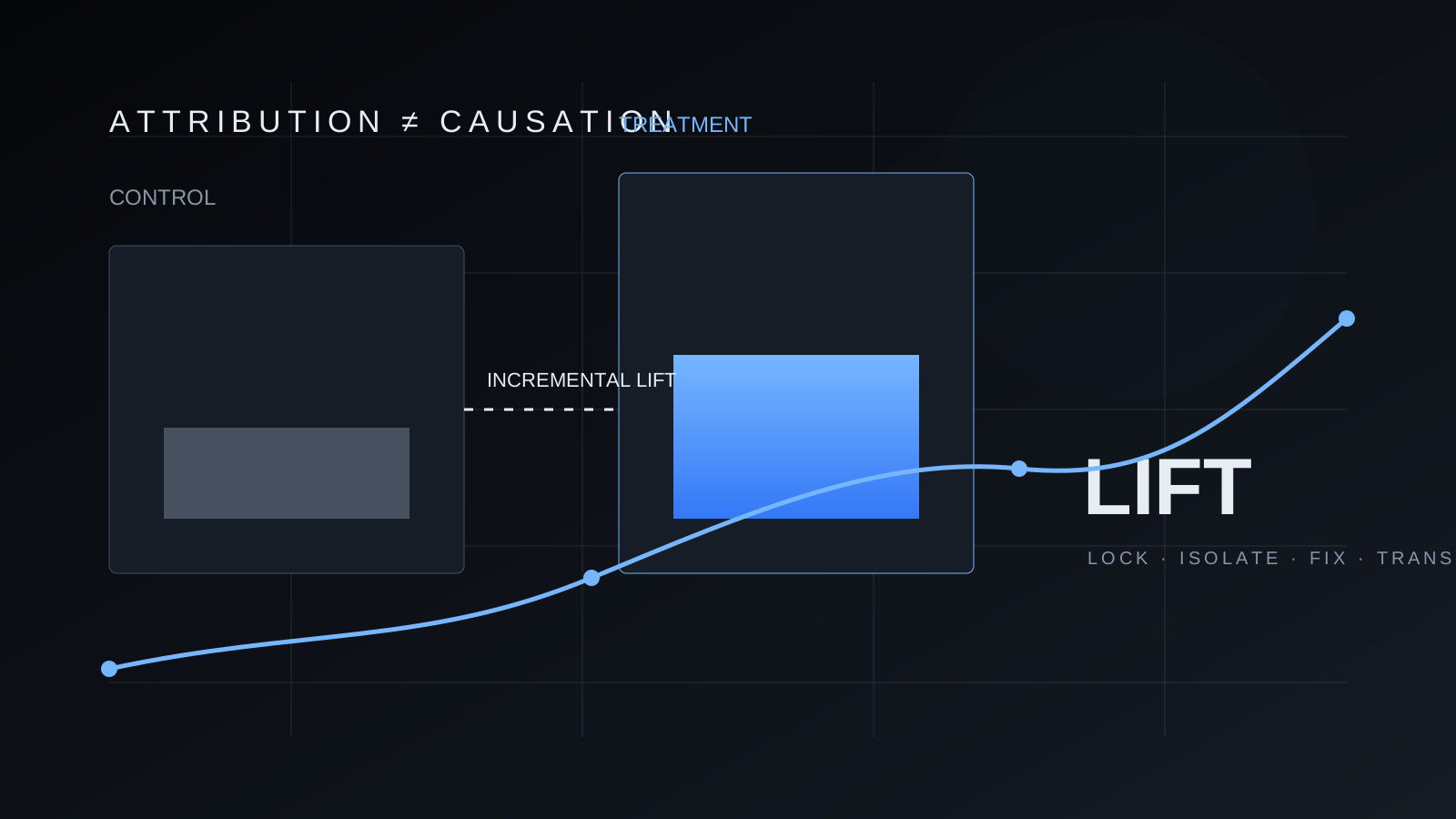
Marketing incrementality is the business outcome that would not have occurred without the advertising intervention. Measuring it requires a comparison between a group that receives advertising and a credible control that does not. The difference between their outcomes is the estimated incremental effect.
Attribution remains useful for daily operations, but it answers a different question. It allocates conversion credit to clicks, impressions or channels according to a chosen model. It does not prove that the credited touchpoint caused the conversion. A customer who already intended to buy may click a retargeting ad, allowing the platform to claim a sale that would have happened anyway.
NUMEDIA therefore uses two measurement layers. Attribution helps teams operate campaigns quickly. Periodic experiments test how much of the reported result is truly additional. Budget decisions can then follow incremental economics rather than a single platform metric.
Why accurate tracking is necessary but not causal evidence
A reliable purchase event, stable transaction ID and reconciled revenue are prerequisites. An experiment built on duplicated orders or inconsistent value definitions cannot produce a useful answer. Yet technically perfect tracking still records only what happened after an ad interaction. It does not reveal the counterfactual outcome for a comparable customer who was not exposed.
This gap matters most for brands with strong organic demand, repeat customers and large retargeting pools. A campaign may report excellent ROAS because it reaches people who are already close to buying. Its incremental value can be much lower. The reverse also happens: prospecting media may receive little last-click credit while creating demand that later converts through search, email or a direct visit.
An experiment does not replace campaign diagnostics. It adds a causal layer that supports a stronger decision to scale, repair, constrain or stop an investment.
| Measure | What it tells you | What it does not prove |
|---|---|---|
| Platform ROAS | Value the platform attributed to its ads | That those sales would disappear without the ads |
| GA4 attribution | How a model allocated credit across measured touchpoints | The complete causal effect of one channel |
| Marketing mix model | Estimated channel contribution over time | Causality without assumptions and calibration |
| Controlled experiment | Outcome difference between treatment and control | That the same effect will persist in every context |
The NUMEDIA LIFT framework for decision-ready experiments
L is Locked outcome. Before launch, define one primary business outcome, its data source, time window and treatment of refunds. Switching among purchases, revenue and platform conversions after seeing the data turns evidence into a flexible narrative.
I is Isolated control. Treatment and control must be comparable, with advertising exposure as the intended difference. User-level holdouts benefit from random assignment. Geo tests require markets with similar pre-test behaviour, sufficient media separation and visibility into other commercial changes.
F is Fixed design. Predefine the hypothesis, duration, budget, groups, exclusions, minimum meaningful effect and analysis. Do not stop because an interim number looks positive. Do not introduce a promotion into only one group unless that promotion is the intervention being tested.
T is True economics. Translate lift into incremental cost per acquisition, incremental revenue, contribution after variable costs and iROAS. Additional orders are not a commercial win when discounts, returns, cost of goods and media spend erase the contribution.
Choose the design around the decision, not the tool
A campaign A/B experiment is often the fastest way to test a change inside one campaign. Google Ads can split traffic and budget between an original and an experimental version. That is useful for comparing tactics, but it does not necessarily answer what would happen without the advertising programme itself.
User or geographic holdouts are stronger designs for causal lift. Google Conversion Lift compares exposed and control groups and, when available for the account, can report absolute and relative lift, incremental conversion value, iCPA and iROAS. A geo design becomes useful when user-level randomisation is unavailable, offline outcomes matter or several channels must be measured together.
Independent geo experimentation can support cross-platform decisions. Google's open-source Meridian GeoX is publisher agnostic, supports holdback, go-dark and heavy-up designs, and can use experiment results to calibrate a marketing mix model.
| Business question | Useful design | Primary limitation |
|---|---|---|
| Is a new campaign setting better? | Campaign A/B experiment | Compares variants, not necessarily advertising versus no advertising |
| How many extra conversions did a platform cause? | User-level Conversion Lift | Eligibility, volume and platform constraints |
| What is the effect of a channel or channel group? | Geo holdout or go-dark test | Market matching, spillover and seasonal noise |
| How should long-term budgets be calibrated? | Experiments combined with MMM | The model still depends on data quality and assumptions |
Confirm that the test can detect a useful signal
The most common reason for an inconclusive result is not an exotic statistical failure. It is too little conversion volume for the noise and expected effect. A small market, infrequent purchases or volatile weekly sales may require a longer test, pooled regions or a carefully chosen upstream outcome. That does not justify replacing the commercial objective with an easy but meaningless metric. It means the design must fit reality.
Estimate the baseline conversion rate, variance, minimum effect that would change the decision and opportunity cost of withheld exposure. Google recommends a 50 percent split for the best comparison in its campaign experiments, but that is not a universal rule for every lift study. Large advertisers may obtain enough power from a smaller control, while a small account may remain underpowered even with half of its traffic withheld.
If the design has little chance of detecting a commercially relevant effect, do not launch it merely to produce a report. A data collection plan, a combined-market test or a conservative interim budget can be more honest.
From hypothesis to incremental ROAS
Start with the decision rule. For example: if the lower end of the estimated iROAS range remains above the contribution threshold, increase spend; if the range includes a material loss, revise the campaign and repeat the test. This turns a result into an operating decision.
Lock the outcome and data. Ecommerce tests should use confirmed backend orders, subtract returns within a predefined window and specify whether value includes tax and delivery. Lead generation should use qualified leads or opportunities when the volume supports it.
Next, assign groups and investigate contamination. Document who can see the ads, which campaigns are included, whether customers move between regions and whether another channel is changing the offer at the same time. Then allow the experiment to run without unplanned interventions.
At completion, estimate both the difference and its uncertainty. Absolute lift is the extra conversions or value. Relative lift compares that increase with the control outcome. iCPA divides test cost by incremental conversions. iROAS divides incremental value by incremental spend. A commercial review should also calculate incremental contribution after variable costs.
Record the period, audience, offer, creative and limitations with the result. An experiment measures a defined context. It is not a permanent coefficient for a channel.
- Predefine the hypothesis and the budget action linked to each outcome.
- Use one primary metric from a documented source of truth.
- Specify the minimum commercially meaningful effect.
- Check treatment and control comparability before launch.
- Fix duration, budget and stopping rules in advance.
- Log promotions, pricing changes and operational disruptions.
- Report lift, uncertainty, iCPA, iROAS and contribution.
- Schedule the next test around the largest remaining budget question.
How to interpret negative and inconclusive lift
Negative lift does not prove that a channel can never work. It can mean that the tested campaign was inefficient in that period, organic demand was sufficient in the control, or an external promotion obscured the effect. Validate execution first, then interpret the commercial meaning.
An inconclusive result is not the same as zero impact. It means the data and design cannot clearly distinguish among a positive effect, a small effect and random variation. The next action may be a longer test, a larger sample, pooled markets or reduced spend until better evidence is available. Selecting only the point estimate while ignoring a wide interval creates false certainty.
A positive result must still clear the economic threshold. If incremental revenue is real but contribution after costs is negative, the campaign needs a better offer, audience or acquisition cost rather than a victory lap.
A 90-day measurement cadence for a lean team
Use the first month to reconcile the source of truth, definitions and baseline. Select one decision with material budget exposure, such as retargeting, branded search or a prospecting channel. Check volume and select a viable design.
Run one clean experiment during the second month. Avoid testing five changes at once. Monitor delivery, group balance, data latency and external events, but keep the hypothesis fixed.
In the third month, complete the analysis, make the decision and document the calibration. Put the next experiment against the largest unresolved question. Over time, this creates a measurement library showing where platform ROAS tends to represent incremental value and where attribution consistently overstates or understates impact.
Sources and methodology
- About Conversion Lift (Google Ads Help, accessed 22 September 2026)
- Set up a custom experiment (Google Ads Help, accessed 22 September 2026)
- Meridian GeoX (Google for Developers, accessed 22 September 2026)
- Meridian FAQs: experiments and causal calibration (Google for Developers, accessed 22 September 2026)
- Estimating Ad Effectiveness using Geo Experiments in a Time-Based Regression Framework (Google Research, accessed 22 September 2026)
Frequently asked questions
What is marketing incrementality?
It is the additional business outcome that would not have happened without the advertising intervention. A credible treatment and control comparison is used to estimate it.
What is the difference between ROAS and iROAS?
ROAS normally divides platform-attributed value by spend. iROAS uses only the incremental value estimated by an experiment, making it closer to causal business return.
Can GA4 measure incrementality?
GA4 can supply behavioural and conversion data, but its standard attribution reports are not controlled experiments. Causal impact requires an appropriate experimental design.
What is a geo experiment?
Comparable markets are assigned to treatment and control, and advertising is intentionally changed only in treatment markets. The outcome difference is used to estimate lift.
How often should a business run lift tests?
Run them when a decision materially affects spend, after major channel changes and periodically for recalibration. Market conditions, creative and offers change, so one result is not permanent.
What should we do with an inconclusive result?
Do not label the impact zero. Review power and execution, then extend, enlarge or redesign the test, or use a conservative budget scenario until stronger evidence exists.