Ecommerce and CRO · 12 min read
Ecommerce site search optimization: from query to purchase
Better site search connects the language shoppers use with products they can actually buy. The FIND framework turns query analysis, catalog quality, relevance and measurement into a practical improvement plan.
Help the shopper complete a task
Improve site search by connecting customer language to product data, ranking useful matches and removing dead ends. Start with actual queries before replacing your search technology. When shoppers cannot find a product you already sell, acquiring more traffic can simply expose more people to the same unresolved problem.
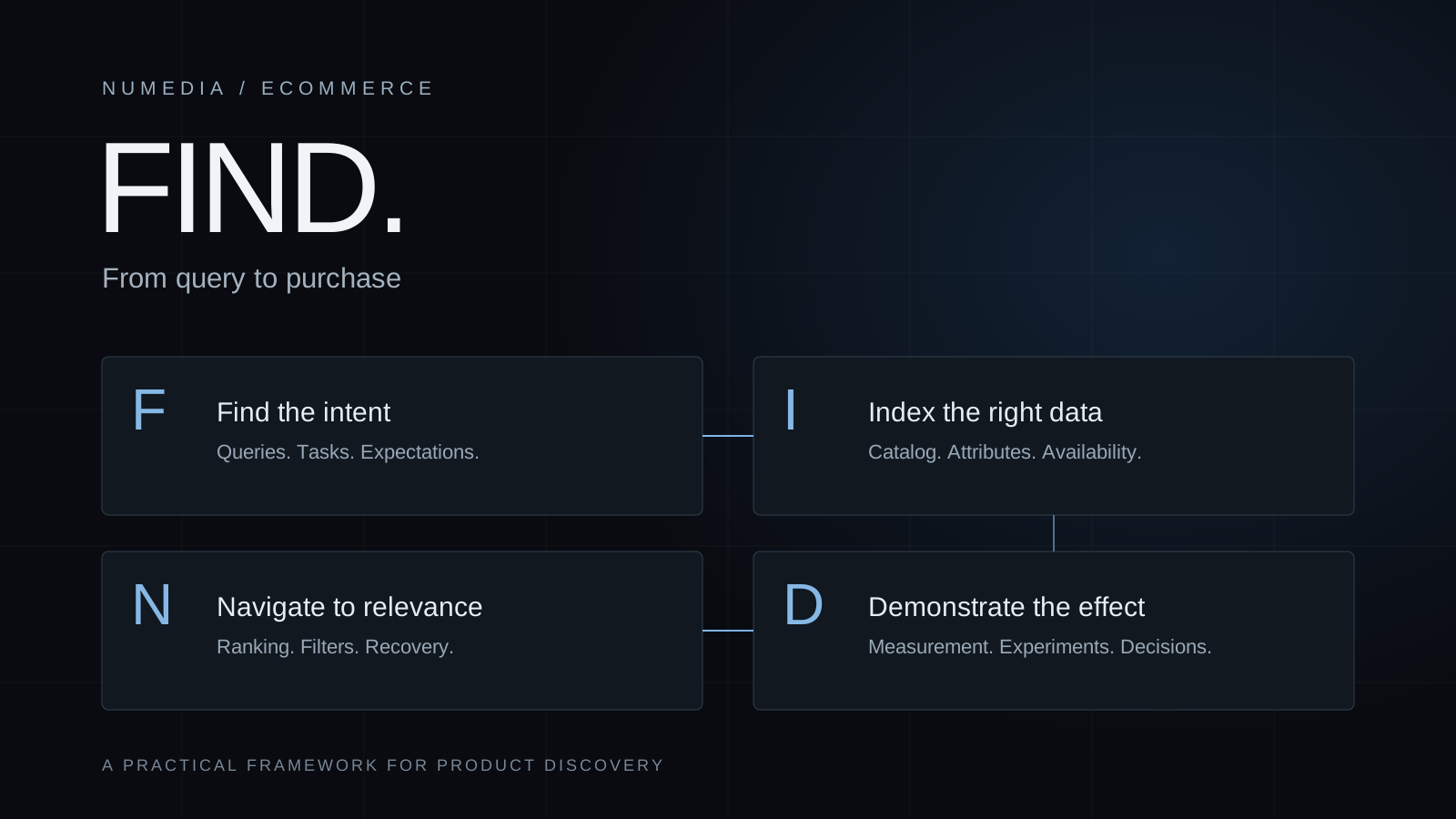
NUMEDIA proposes FIND as a working framework: Find the intent, Index the right data, Navigate to relevance and Demonstrate the effect. It provides a sequence for diagnosis and prioritization. It is not a promise of a particular conversion uplift.
This guide concerns search inside an online store. Its purpose is to help visitors choose a suitable product after arrival. Organic search visibility, Google Shopping feeds and checkout optimization are related workstreams with different success criteria.
F: build a set of search tasks
Export queries for a defined period and group them by intent. Separate exact models, product categories, attributes, use cases and compatibility. Baymard’s original usability research documents different query types. Your audit should therefore test a range of shopping tasks rather than only correctly spelled product names.
Start with twenty to fifty representative queries. This is a suggested working sample, not a statistical standard. Include frequent queries, zero-result searches, searches without clicks and strategically important products. For a smaller store, add language from support requests and sales conversations.
Record the expected result and unacceptable alternatives for each task. A spare part for model Y is not a successful match for a query specifying model X. A list of products above a shopper’s stated budget does not resolve a budget-constrained search.
| Intent | Example query | Acceptance check |
|---|---|---|
| Exact product | Model AB-240 | Correct model and variants |
| Attribute | Black 20 L backpack | Color and capacity match |
| Use case | Weekend travel bag | Products fit the intended use |
| Compatibility | Filter for model X | Verified compatibility |
| Purchase support | Shipping and returns | Relevant information page |
I: catalog data sets the ceiling for findability
Search cannot reliably repair missing or contradictory product data. Maintain stable product IDs, names, categories, brands, variants, SKUs, important attributes, stock and sale eligibility. Separate searchable fields from filter attributes and display fields. One field does not necessarily perform all three roles well.
Inspect variants closely. A search for a blue jacket in size M should lead to the appropriate selection, rather than a default red variant that forces the shopper to start again. Availability, price and product-page state should agree with the result card.
Build a vocabulary of customer expressions and map it to verified product attributes. Abbreviations, alternative spellings and everyday product names belong in the test set. Do not invent attributes or add irrelevant wording to descriptions merely to increase matches. For technical products, factual constraints take priority over broad semantic similarity.
N: make relevance the foundation of ranking
First establish whether a result satisfies the task. Then consider availability, commercial priorities and merchandising. A higher-margin product that violates an explicit requirement is not a good first result. Give every important ranking rule an owner, a rationale and a review date.
Use a simple editorial scale for leading results: relevant, partly relevant or irrelevant. Save the original results for your fixed query set and compare them after each change. For example, review the share of relevant products among the first five results. This audit score helps detect regressions; it does not establish a sales effect.
Provide meaningful ways to narrow the selection. Furniture shoppers may need dimensions and materials, spare-part buyers need model compatibility, and clothing shoppers need size and color. Active filters should be understandable and easy to remove.
Diagnose zero results before choosing a remedy
Zero results can indicate an incomplete index, different wording, a typo, an over-restrictive filter or a product you genuinely do not carry. These causes require different responses. Showing the same unrelated bestsellers for every failed query hides the diagnosis and gives the shopper little reason to trust the recovery path.
Preserve the query in the input. Explain that there was no exact match and offer an appropriate next step: a spelling correction, removal of a filter, a relevant category or clearly labeled alternatives. Do not present a broader accessory match as verified compatibility.
Also investigate searches that return results but receive no clicks. A populated page of unsuitable products can be as unhelpful as an empty page. Review examples manually to distinguish ranking problems from unclear cards, missing prices, slow loading and genuine assortment gaps.
Test the complete mobile journey
On a phone, test the task from opening search to returning from a product page. Check whether the keyboard obscures suggestions, submission works, and the query, filters and scroll position survive the return. A search overlay that opens successfully is only the beginning of the journey.
Keep suggestions manageable and distinguish product matches from suggested queries. Provide a visible field label, keyboard controls, useful loading feedback and understandable error messages. Photography and animation should support the task without delaying it.
Monitor failed requests and response times under realistic conditions. When the shopper edits a query while a request is pending, an older response must not overwrite newer results. This implementation defect can look like poor relevance if the team only inspects the final screen.
For Shopify, verify the current controls
At the review date, Shopify documents built-in semantic understanding and product boosts in Search & Discovery. The current customization page does not list manual synonym-group editing as an available control. Verify the actual store settings before planning implementation from an older tutorial.
Shopify also states that semantic understanding uses product information rather than images. A theme can override result-type settings. Validate the storefront response after a change instead of assuming that a saved setting determines the shopper’s experience.
Apply the same discipline to WooCommerce or a custom storefront: confirm indexed fields, language support and stock refresh behavior. Check the installed plugin and version before committing to a feature or a delivery estimate.
D: connect result exposure to the commercial outcome
GA4 enhanced measurement can collect view_search_results and search_term from configured URL query parameters. This alone does not capture the full autocomplete journey or a search interface that never changes the URL. Inspect the actual trigger and avoid sending the same event twice.
For a custom measurement plan, connect result exposure, product selection, cart addition and purchase. Google documents ecommerce events including view_item_list, select_item, add_to_cart and purchase. Use consistent product IDs and, where needed, a search identifier of your own. result_count and search_id are suggested custom parameters, not fields that GA4 automatically guarantees.
Shopify provides reports for searches without results and without clicks. Its documentation specifies that search performance reports cover the results page rather than predictive-search interactions. Align time periods, denominators and coverage before comparing data sources.
| Measure | Agreed definition | Diagnostic use |
|---|---|---|
| Zero-result rate | Zero-result searches / valid searches | Index failures or assortment gaps |
| Post-search click rate | Searches with a click / searches | Relevance and presentation |
| Query reformulation | Searches reformulated before a click / searches | Difficulty completing the task |
| Purchase after exposure | Purchasers / exposed users in the assigned group | Commercial experiment outcome |
| Errors and latency | Failed requests and response-time distribution | Technical reliability |
Higher conversion among search users is not causal proof
People who use search may already have stronger purchase intent. A higher conversion rate in this group does not tell you how many additional sales search caused. Equally, a zero-result search is not automatically a lost order.
With sufficient traffic, randomly assign eligible visitors to the existing or improved experience. Establish assignment at exposure and do not condition the analysis on a later click. Define the primary business metric, duration, decision rule and guardrails such as revenue per visitor, errors and returns before launch.
With limited traffic, combine fixed task testing, observed usability sessions and descriptive period comparisons. Document concurrent changes to acquisition, offers and inventory. The evidence can guide the next decision, but report it as observed change rather than a reliable estimate of incremental revenue.
A practical first-month implementation plan
In week one, establish measurement and the baseline task set. In week two, repair missing data, incorrect variants and clear technical defects. In week three, improve relevance and failed-search recovery. In week four, check for regressions and prepare a controlled experiment where the available sample supports one. This is a proposed sequence, not a guaranteed timetable for every store.
Prioritize by frequency, severity, the value of the affected assortment and effort. Frequency alone is insufficient: demand for a product you do not intend to stock may matter less than a less frequent failure affecting your core range.
For this type of project, NUMEDIA connects analytics, the catalog data model, user experience and development. The initial review should produce a concrete backlog with owners, evidence, proposed fixes and acceptance criteria. Release an improvement only after the relevant tasks pass again.
- Define the measurement period and coverage.
- Save baseline queries and expected results.
- Separate catalog, index, interface and assortment problems.
- Check the mobile journey and return to results.
- Repeat the same acceptance tasks after every change.
- Describe sales effects according to the strength of the evidence.
Sources and methodology
- Ecommerce Search UX 2026: Search Query Types (Baymard Institute, accessed 2026-10-18)
- Modifying search with Shopify Search & Discovery (Shopify, accessed 2026-10-18)
- Search behavior in your online store (Shopify, accessed 2026-10-18)
- Shopify Search & Discovery reports and analytics (Shopify, accessed 2026-10-18)
- Enhanced measurement events (Google Analytics, accessed 2026-10-18)
- Measure ecommerce (Google for Developers, accessed 2026-10-18)
Frequently asked questions
What is ecommerce site search optimization?
It improves search within the store: catalog data, query interpretation, ranking, the user journey and measurement. The objective is to help visitors find suitable products and continue toward purchase.
Should we replace the search engine first?
Audit data and representative queries first. Replacement makes sense when the current system cannot meet demonstrated requirements or reliability needs. Poor catalog data remains a constraint after a technology change.
How should we handle searches with no results?
Classify the cause. Repair index and data failures, offer spelling corrections or filter removal, and use genuine assortment gaps to inform commercial planning. Clearly label alternatives.
Does GA4 automatically measure every search interaction?
No. Enhanced measurement relies on configured URL parameters. Interfaces without URL changes and interactions with predictive suggestions require validation and may need additional event implementation.
How can we establish additional sales?
A properly designed randomized experiment offers stronger evidence than comparing search users with other visitors. Those groups may differ in intent before search is used.