AI agent implementation · 1/5 · 10 min read
Agentic workflow design: building a reliable business process
An agentic workflow lets an AI agent select steps and use tools within a defined business process. Reliability depends on the surrounding design: the trigger, permitted decisions, action verification and a clear definition of completion.
Start with a business outcome
A useful starting point is a bounded task: turn an incoming enquiry into a verified quotation draft for an accountable reviewer. “Automate sales” leaves too much unresolved. Define an output that someone can accept or reject and name the person responsible for the process.
This series uses a hypothetical distributor receiving B2B quotation requests. The agent interprets a request, checks product information and prepares a draft. It is an educational example, not a claim about a NUMEDIA client. Reusing it connects architecture, the process brief, integrations, approvals and production rollout.
Define a negative completion condition too. Persuasive prose alone is insufficient. The draft needs suitable products, a current factual basis and visible missing information. When those conditions cannot be met, a documented handoff is a legitimate outcome. The system should explain what is missing instead of treating uncertainty as completion.
Separate predefined flow from agent decisions
Anthropic’s architecture guide distinguishes workflows with predefined paths from agents that choose their next steps dynamically. For a business deployment, combine a stable process structure with bounded areas where a model interprets unstructured input or selects an appropriate tool.
In the distributor example, application rules define eligible product categories, required fields and escalation conditions. The model can classify a request and suggest a match between customer language and the catalog. Calculating a quotation total should remain a verifiable operation over confirmed data.
Add autonomy when you can identify the problem it resolves. A known sequence over structured information may need only a straightforward workflow. When each case needs different lookups, give the agent a limited set of choices and an explicit stopping rule. Complexity should earn its place through demonstrated usefulness.
Assign six distinct responsibilities
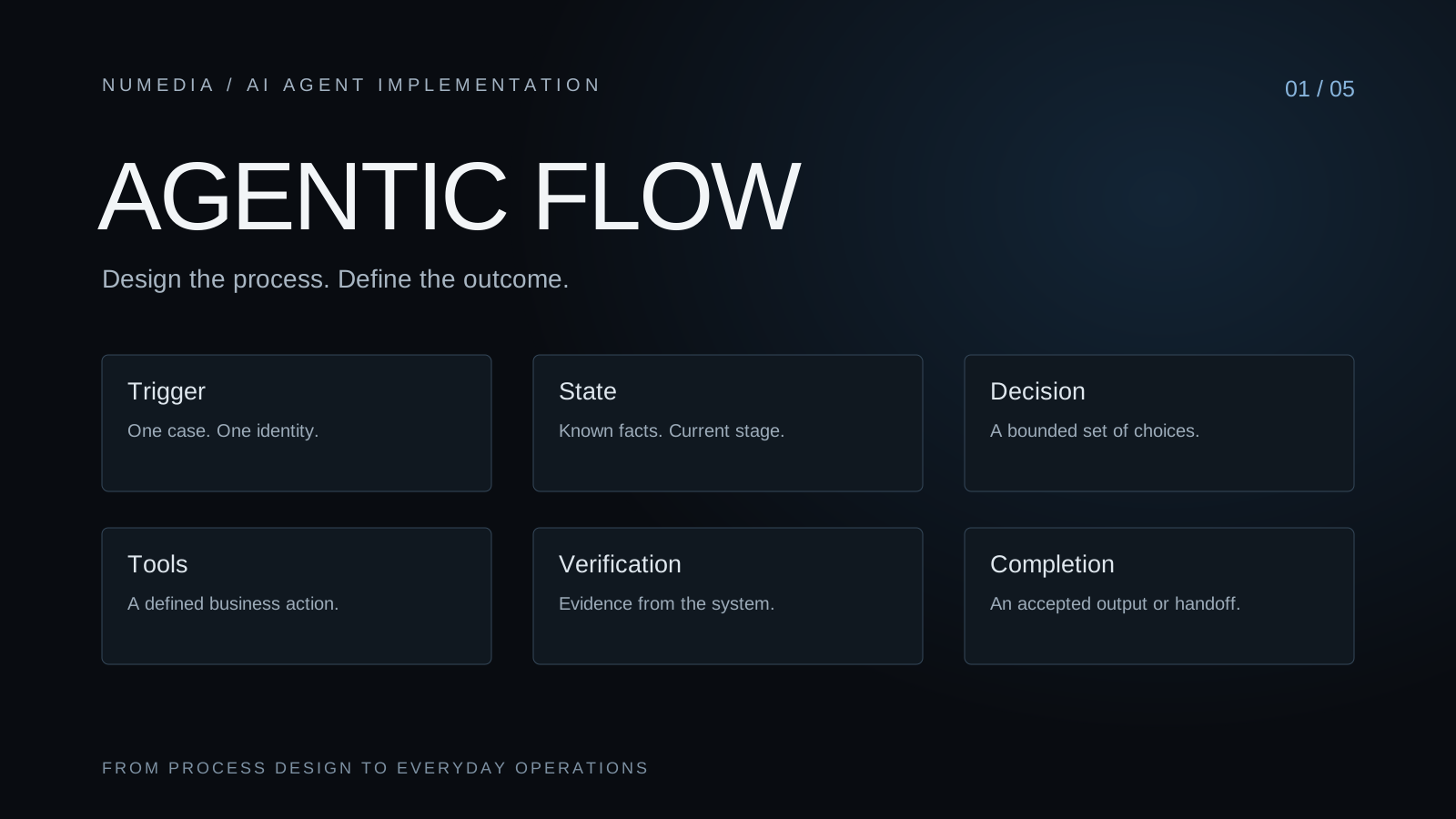
The first responsibility is triggering: what creates a case and how duplicates are recognized. The second is context: which information belongs to this case. The third is decision-making. The fourth is acting through tools. The fifth is checking the observed result. The sixth is completion or handoff.
This separation improves diagnosis. An incorrect product recommendation may reflect poor catalog data, a failed lookup or misinterpretation. It is not automatically a model problem. Give each responsibility an input, an output and someone who can explain whether the result is correct.
Use business language in the design. “Retrieve current availability for these product codes” is a more useful step than “the agent thinks.” Each step should establish an observable state. A private reasoning transcript is neither necessary nor sufficient evidence that the business action happened.
| Component | Key question | Completion evidence |
|---|---|---|
| Trigger | What creates a new case? | Unique case identifier |
| Decision | What may the agent choose? | Choice within an allowed set |
| Tool | What action happens? | Verifiable system response |
| Handoff | When does a person take over? | Assigned task with a reason |
| Completion | When is the case resolved? | Accepted output or recorded exception |
Keep process state outside the conversation
A case needs an identifier, current stage, source references, draft version and records of completed actions. A chat window alone is not an operational ledger. After a session interruption, the executor must know what is confirmed, what is waiting and which action must not be repeated.
LangGraph documentation distinguishes thread-scoped checkpoints from application data stored across threads. That is a useful architectural example rather than a requirement to adopt a particular framework. A case ledger and a separate knowledge store can implement the same conceptual separation.
For the distributor, stages might include new request, information needed, product verification, draft ready, awaiting approval and completed. Record why each transition occurred. A changed customer requirement should create a new draft version, rather than silently making an earlier proposal valid for a different request.
Treat the tool contract as an action boundary
Describe each tool through its purpose, required parameters and possible outcomes. Instead of returning only “success,” a draft-creation tool should return the draft identifier and status. The next step can then verify that the expected record exists in the destination system.
Separate preparation from execution. Product lookup, availability reading and drafting have different consequences from sending a quotation. Represent them as distinct operations in both the design and implementation. This enables appropriate conditions, checks and levels of autonomy for each operation.
Plan for an ambiguous response. A connection that times out after a write request does not prove that the write failed. Check the destination record before trying again. The integration article develops this issue into a concrete plan for reliable CRM and ERP actions.
Bound loops and define exit routes
An agent may make several attempts to resolve missing information, but the boundary should be explicit. Set an attempt limit, a time budget and a handoff condition. Consider the employee’s waiting time and the business value of the open case, not only the price of another model call.
Distinguish temporary technical failure from business ambiguity. A retry may resolve a temporarily unavailable catalog. It cannot establish a customer’s required machine model when that information was never supplied. The second situation needs clarification, not further repetition of the same analysis.
Valid exits include an accepted draft, a clarification request, rejection of an unsuitable case and technical escalation. A single “done” status loses the reason a case left the automated route. Different exits need different follow-up work and should remain distinguishable in reporting.
Observe transitions and outcomes
OpenTelemetry describes traces as a way to connect operations across a request. Applied to an agentic workflow, this helps connect a business case, tool calls and the eventual outcome. Token usage alone cannot show whether a quotation is correct or a case is stuck.
An operational view should identify where cases stop, how often outputs need correction and how much human work remains. Separate model execution time from system waits and approval queues. Otherwise, the team may optimize a small technical component while leaving the main delay untouched.
Begin testing with a compact set of representative cases and known expected outcomes. Include incomplete input, an unavailable tool, a duplicated event and a changed requirement. The objective is to verify the whole flow, rather than demonstrate one attractive successful response.
Worked example: an incomplete quotation request
Suppose a customer states the product type and intended use but omits the required variant. The trigger creates a case and the intake check marks the missing attribute. The agent checks whether the rest of the request contains it. If not, it prepares a focused question and moves the case into a clarification state.
When clarification arrives, attach it to the existing case. Do not create a parallel workflow merely because a new message or event appeared. The system identifies what changed, updates state and continues with product identification. Receiving clarification does not automatically confirm every downstream fact.
After a confirmed match, the lookup returns the product code, source reference and availability. A calculation uses the agreed price basis. The agent assembles a draft with exceptions visible, and validation checks required fields. The draft then enters the review queue with a reason for human involvement.
This example shows why explicit states are more useful than one large instruction. At any point, the team can identify what is missing, who must act and what a new input will trigger. A changed requirement after drafting does not skip verification merely because an earlier draft already exists.
Deliver a process map before committing to the build
The first useful deliverable is a process map covering the trigger, states, sources, decisions, tools, checks and exits. Keep a list of unresolved questions beside it. Unclear business rules are project work; resolve them before they become unpredictable production behavior.
NUMEDIA connects this design to accountable people and an implementation plan. Platform selection becomes productive when the requirements are clear enough to compare alternatives. The process should remain understandable to a department leader who does not know the development framework.
The next step is the process brief. It turns the architecture into an implementation specification with a task boundary and acceptance criteria. Once the team agrees on a successful result, it can plan integrations and the pilot with much less ambiguity.
Sources and methodology
- Building effective agents (Anthropic, accessed 2026-10-19)
- Workflows and agents (LangChain, accessed 2026-10-19)
- Persistence (LangChain, accessed 2026-10-19)
- Traces (OpenTelemetry, accessed 2026-10-19)
Frequently asked questions
What is an agentic workflow?
It is a business flow in which an AI agent selects steps and uses tools within defined limits. The organization sets the outcome, boundaries, checks and completion conditions.
Do we need multiple agents?
Not necessarily. Start with the simplest design that meets the task criteria. A separate agent needs a distinct responsibility and a verifiable handoff contract.
Is a model conversation a complete automation?
An operational process also needs case state, system integrations, action verification and exception handling. Conversation can be its interface without being the whole system.
What makes a good first workflow?
Bounded inputs, a verifiable output, accessible data and an accountable owner. When information is missing, it can hand work to a person without losing case state.