AI agent implementation · 3/5 · 10 min read
Integrating AI agents with CRM, ERP and business tools
A CRM or ERP integration works when the agent uses the right records and the organization can verify each action’s effect. API access is only the start. Clear data meanings, bounded operations and incomplete-response handling make the connection operational.
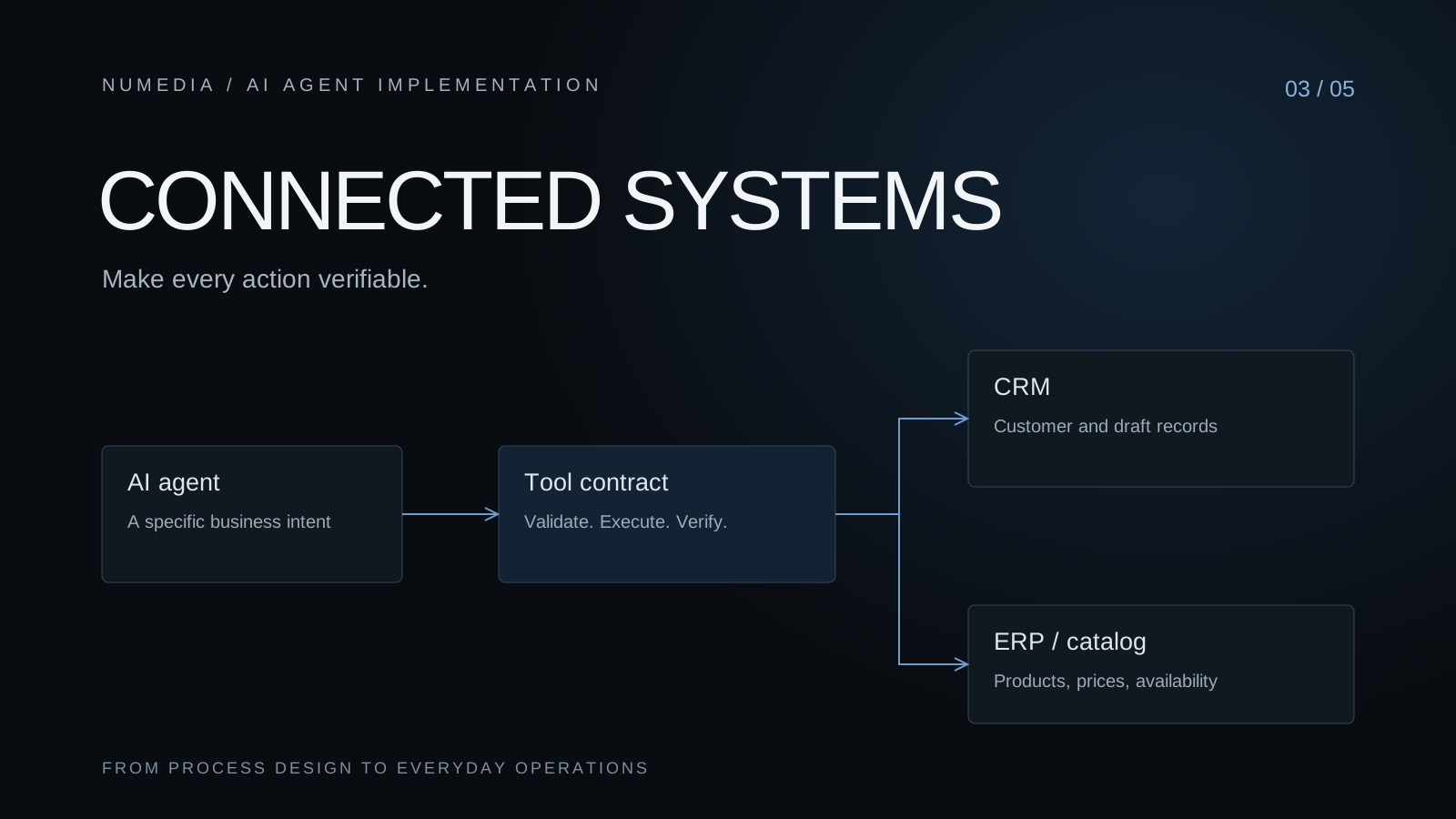
Inventory the facts that determine the outcome
The hypothetical distributor’s quotation agent needs customer records, products, prices and availability. Those facts may live in different systems. Before connecting anything, list the fields, their meaning, accountable steward and authoritative source.
“Customer” may refer to an organization, a contact or the billing entity. “Available” may mean physical stock, unreserved inventory or an expected delivery. Without agreed definitions, a model can combine correctly retrieved fields into an incorrect commercial conclusion.
Include definitions in the integration plan. A quantity has a unit, a price has a currency and validity period, and a product has a code or variant. A technically successful API response does not make an ambiguous field a suitable basis for autonomous action.
Expose a business operation rather than an unrestricted interface
A useful tool performs a recognizable task: locate a customer by a confirmed identifier, retrieve a product price or save a quotation draft. An unrestricted request interface increases the number of choices the model must assemble correctly for every case.
Anthropic’s tool-design guidance discusses clear descriptions, useful responses and testing tool use. For a business implementation, the essential contract states what the operation does and what it does not do. Saving a draft should not unexpectedly send a quotation to the customer.
Define required parameters, valid values, preconditions and possible outcomes. Return a business identifier and state. A person or downstream step should recognize the result without reading the entire model conversation. Keep tool naming aligned with how the operating team describes its work.
Resolve record identity before writing
Two organizations can have similar names, and the same person may appear in several records. Names alone are insufficient for silently merging identities. Use confirmed identifiers and make ambiguous matches visible.
The agent can suggest a candidate, but selecting the correct CRM record must follow an agreed rule. Where several matches remain plausible, hand the choice over. A write to the wrong record can be technically successful while sending the rest of the workflow down an incorrect path.
Apply the same discipline to product codes and document identifiers. Once identity is confirmed, carry it through the flow. Do not repeatedly turn it into a descriptive label and resolve it again. Stable identifiers reduce opportunities to lose an initially correct selection between systems.
Separate reading, preparation and mutation
Reading a price list, calculating a proposal and writing a quotation are distinct responsibilities. The first retrieves facts, the second constructs an output and the third changes a system. Design separate checks and operating limits for each.
An initial integration can restrict the agent to preparing a draft in an agreed record system. Reviewed work then follows the established business procedure. Expand autonomy later when you have evidence that the particular task behaves correctly, including the difficult cases.
Pass only the information the operation requires. This improves clarity as well as operational discipline. A large bundle of unrelated records makes it harder to determine which information belongs to the current case and complicates diagnosis when a result is wrong.
A retry must not become a second business action
The AWS Builders’ Library explains how retrying after a timeout can duplicate an effect and how a stable request identifier supports idempotent handling. This matters for agents because retries may originate from both the runtime and the model.
Use a stable action key for one intended draft creation. If the first response is missing, the next attempt should determine whether the draft already exists. A technical retry is not a new business intent. A revised quotation, however, needs a new version rather than reusing the old action indiscriminately.
A prompt alone cannot establish idempotency. The destination or integration layer must enforce the contract and retain the execution record. Test the case where the write succeeds but its response is lost. Ordinary successful calls will not reveal that class of failure.
Classify errors by the permitted next action
Temporary unavailability, an invalid parameter, a missing record and an ambiguous customer are different outcomes. Return a machine-distinguishable category with a short explanation. Then specify whether the system may retry, needs another input or must hand off.
Rate limiting is not solved by increasingly rapid repetition. An invalid product code is not fixed by making the identical call again. Let the integration layer manage technical waits and bounded retries while the agent understands the business consequence: a price remains unconfirmed or a product cannot be identified.
Make partial responses explicit. Data for two of three requested items is not a complete quotation. Retain successful results, flag the unresolved item and choose the next route. Hiding incompleteness inside fluent prose creates an inaccurate impression that work is ready.
| Outcome | What is known | Next step |
|---|---|---|
| Success with record ID | The write is confirmed | Verify state and proceed |
| Timeout after write request | The effect is uncertain | Check the action ledger |
| Missing input | The request is incomplete | Ask for clarification |
| Multiple customer matches | Identity is ambiguous | Hand off selection |
| Partial result | Not all items are confirmed | Retain successes and flag the exception |
MCP standardizes access descriptions, not business meaning
Model Context Protocol describes tools through names, descriptions and input schemas. This helps standardize connections. It does not determine which internal price list is current, which customer record is correct or what constitutes business success.
Choosing MCP therefore does not replace the data plan or operation contracts. The same principle applies to a direct API or an integration platform. Compare how a solution exposes results, represents failures and supports verification, rather than counting its connectors.
Name the connection owner and retain a change record. When a system changes a field or the meaning of a status, repeat representative cases. An unchanged endpoint does not guarantee unchanged business semantics. Integration maintenance belongs in the operating model from the beginning.
Worked example: the save-draft contract
A proposed save-draft operation receives the case identifier, confirmed customer, proposal version and structured line items. Unstructured prose is not its only business record. Before writing, it validates required fields, eligible product codes and scope. Invalid input produces a clear failure rather than an apparently saved document.
The response contains the document ID, draft status and a record link where available. The agent can use those facts to prepare the reviewer’s next step. It should not say “sent” when the operation did not send anything. Precise statuses reduce incorrect conclusions by people and downstream automation.
On a repeated call, verify that the action key still represents the same intent. An identical request can return the existing draft. Changed line items under the same key should not silently overwrite content already reviewed. Use an agreed update operation or a new version with visible history.
Integration acceptance therefore checks more than whether the CRM accepts a write. Test response loss, repetition, an invalid code and a revised proposal. The contract is useful when the team can identify which document exists and whether the next step may use it in each situation.
Accept the integration through observable outcomes
Acceptance should cover a correct request, duplication, a lost response, partial output, changed input and an unavailable system. Each case needs an unambiguous final record state. A conversation recording in which the agent claims success is insufficient evidence.
Connect events to a business case identifier. Technical traces should locate the operation and its result. We also recommend a link to the created draft and a source-data version where the source supports one. Operations can then verify work without reconstructing it from fragmented messages.
NUMEDIA connects the process brief to actual system capabilities and limitations. The target is a useful business operation with understandable outcomes. The next article explains how to present those outcomes to a person who must approve a proposal or resolve an exception.
Sources and methodology
- Writing effective tools for AI agents (Anthropic, accessed 2026-10-19)
- Tools: Model Context Protocol specification (Model Context Protocol, accessed 2026-10-19)
- Making retries safe with idempotent APIs (Amazon Builders’ Library, accessed 2026-10-19)
- Traces (OpenTelemetry, accessed 2026-10-19)
Frequently asked questions
Does API access make an agent production-ready?
No. You also need field definitions, record identity checks, action verification and explicit failure handling.
What is an idempotent action?
Repeating the same intended action causes no additional effect. A technical retry of draft creation should not produce two drafts.
Does MCP replace a CRM or ERP?
No. It describes and exposes connections. Business data, rules and authoritative records remain in the agreed systems.
Which integration should come first?
The one required by a bounded task in the process brief. Prioritize the business output and source reliability rather than connector count.