AI agent implementation · 4/5 · 10 min read
Human in the loop: approvals and handoffs in agentic workflows
Human in the loop means the process has a designed place for judgment or takeover. A useful handoff includes a concrete proposal, the reason work paused and a meaningful decision. A notification saying “check the AI answer” does not create an operating process.
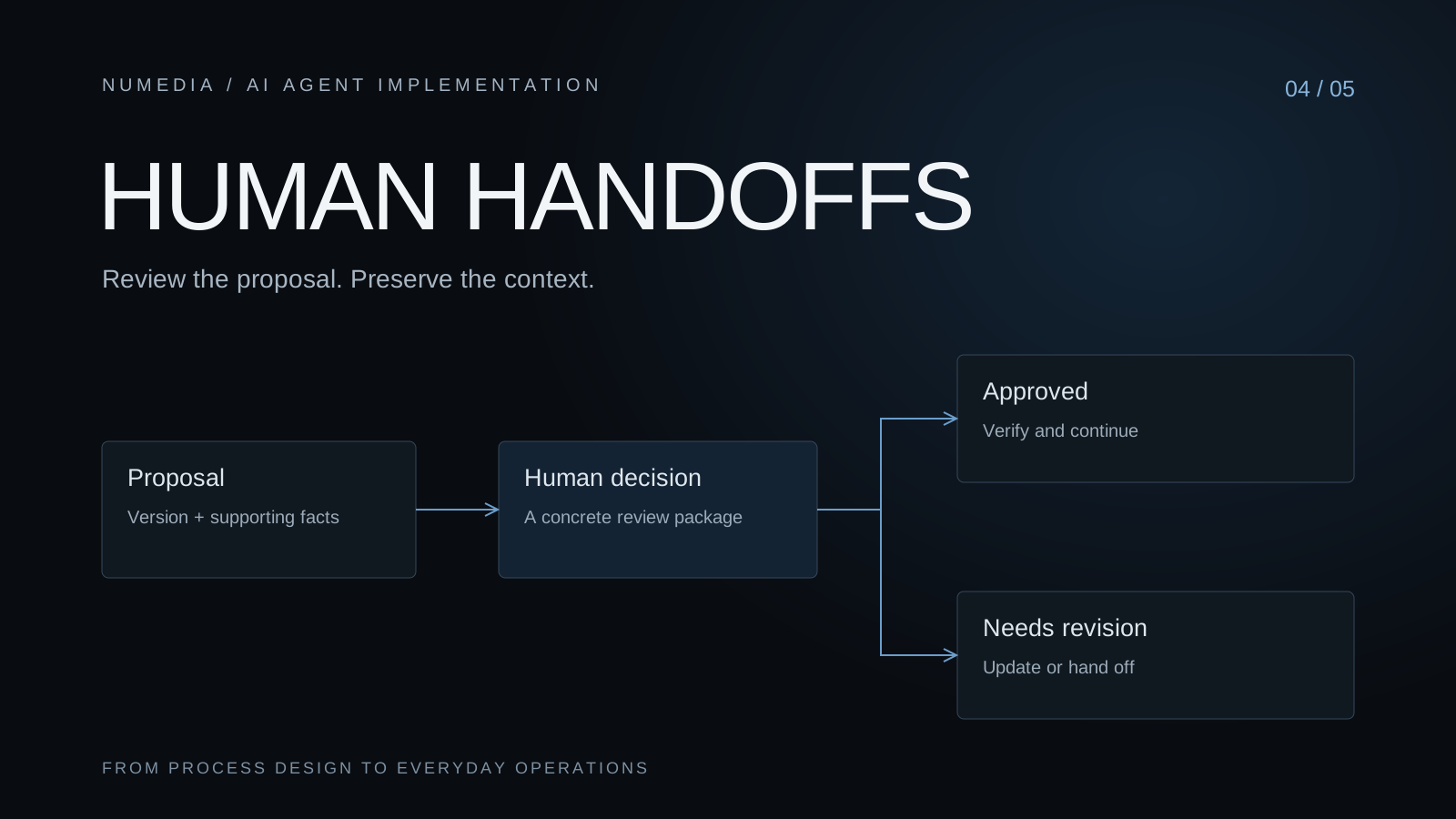
Distinguish approval from taking over a case
Approval means a proposal is ready and a person judges a particular next action. Escalation means the agent could not resolve the task within its scope and someone must continue the work. These outcomes have different needs and should not enter one indistinguishable queue.
In the hypothetical distributor example, a salesperson can approve a completed draft. Ambiguous product identity goes to a product specialist. The first person reviews a prepared result; the second needs to obtain or interpret missing information. Give each the appropriate evidence package.
Include rejection and requests for revision. “No” can mean the proposal is incorrect, information is missing or the case should stop. The chosen reason must determine the next state, rather than causing the system to submit the identical proposal again.
Place human judgment around a defined decision
Review belongs where business judgment or confirmation of a consequence is required. Every catalog read does not need a separate approval. The team does need to understand which decisions have been delegated and which remain with an accountable person.
Design by task category rather than relying only on the model’s self-assessment. “I am confident” is not a replacement for an exception policy. An unsupported product or conflicting source data can require handoff regardless of how assured the response sounds.
Adjust review scope using operational evidence. After a successful pilot, a business owner may reduce routine review for a well-defined drafting task. Record the specific scope of that decision. It should not become an indefinite authorization for unrelated future actions.
Provide a package someone can actually assess
Show the request summary, proposed action, target record, supporting information and unresolved questions. A quotation review should expose the customer, products, quantities, price basis and draft version. The reviewer should not have to reconstruct the case from a sequence of messages.
Highlight changes from the last reviewed version. A quantity adjustment should be easy to identify. A changed customer or quotation content creates a different decision. An approval button without a visible proposal encourages habitual clicking rather than considered review.
Microsoft’s Human-AI Interaction guidelines address interaction when AI is wrong and over time. In an operational interface, apply that perspective through understandable limits, explicit handoff reasons and straightforward correction or takeover controls.
| Information | Purpose | Example |
|---|---|---|
| Decision object | Shows the consequence | Approve draft version 3 |
| Evidence | Enables verification | Current price source and product IDs |
| Pause reason | Explains the need for a person | Two possible product models |
| Decision choices | Defines continuation | Approve, edit, clarify, reject |
| Owner and status | Prevents a lost case | Assigned to sales; waiting |
Bind the decision to a specific proposal version
Tie approval to the case identifier and proposal version. If products, prices or the recipient change, check whether the decision remains valid. Approval of one proposal must not silently authorize a materially different action.
Recheck facts that may have become stale before resuming. A draft using yesterday’s stock information may need an availability refresh. Set validity rules according to the information and process involved; a universal time limit will not fit every task.
OpenAI Agents SDK documentation covers durable approval state and versioning pending tasks. It provides a technical example of a handoff surviving a session interruption. The organization must still define the business meaning of the decision and what information was approved.
Preserve state and prevent duplicate execution
A person may respond after the original web session ends. Retain the stage, proposal, completed actions and resumption route. Once the decision arrives, continue from a valid state rather than restarting the assignment without checking what already happened.
LangGraph documents interrupts that persist state and resume with external input. Whatever framework you choose, inspect which steps may run again during resumption. An action with an external effect needs protection against duplication.
Test a double approval click, decisions from two open windows and a restart during the wait. Each should produce one agreed outcome. The reviewer must be able to see whether a decision was already recorded, has expired or has been executed.
Give the queue an owner and a routing policy
A handoff into a general channel can merely relocate the bottleneck. Assign a primary owner, cover for absence and a way to indicate urgency. Match the operating agreement to actual working hours and specialist availability.
Measure waiting time separately from active review time. A large gap indicates a routing or capacity problem rather than necessarily poor agent quality. Monitor the oldest open cases too. An average can hide tasks that never move forward.
Define the next step when an agreed response window passes. It might notify a substitute or trigger manual process takeover. Silence should not become approval unless that specific rule was deliberately established for the particular task category.
Use feedback to improve the route
Capture reasons for rejection: wrong product, incorrect source, incomplete proposal or out-of-scope case. When most handoffs arise from the same missing field, a better intake form may be the right fix. Another model will not necessarily remove a process-level cause.
Review the reviewers’ work as well. Repeated formatting corrections suggest a template change. A missing fact needed for judgment suggests a better handoff package. The objective is less unnecessary work while maintaining outcome quality, not simply fewer escalations.
A high approval rate is not proof of correctness. People can approve proposals habitually. Periodically inspect accepted cases against the agreed criteria. Evaluation should assess the resulting work rather than merely checking that someone clicked a button.
Worked example: the reviewer’s decision card
The card begins with the decision object: “Review quotation draft for case X, version 3.” A short change summary follows, such as a revised quantity on one line. The reviewer should immediately understand whether this is routine assessment of prepared work or a question requiring additional specialist judgment.
Below the proposal, show supporting records and the verification time for facts material to the decision. Label a suggested product match as a suggestion. A long conversation history should not be the only verification route. Direct record links and explicit unresolved points are more useful for focused assessment.
Offer meaningful routes: approve the prepared proposal, edit and recheck, request clarification or reject the case. Each choice changes status and assigns the next owner. Closing the screen without deciding leaves the case waiting. Closing a window is not a business approval event.
Before continuation, confirm that the card still references the current version. If another employee changed a line item, expose the difference and obtain the appropriate new judgment. This preserves the connection between what the person saw, what they decided and what the system will actually execute.
Treat handoff as a product capability
Acceptance should demonstrate the complete loop: the agent creates a proposal, a person edits it, the system saves the new version and the correct continuation follows. Add a stale proposal, an absent owner and an incomplete decision. Each needs an understandable outcome.
NUMEDIA designs the receiving person’s working experience alongside the agent. That includes useful notifications, retained context and clear status. A well-designed handoff can determine the usefulness of the whole solution more than an additional agent feature.
Once handoffs work, the next question is rollout scope. The final article explains how to move from historical cases into an observed pilot and then expand use while keeping outcomes visible to the operating team.
Sources and methodology
- Guidelines for Human-AI Interaction (Microsoft, accessed 2026-10-19)
- Interrupts (LangChain, accessed 2026-10-19)
- Human-in-the-loop (OpenAI Agents SDK, accessed 2026-10-19)
Frequently asked questions
What does human in the loop mean?
It is a designed human decision or takeover point. The system retains context and resumes according to explicit rules.
Must a person approve every agent action?
No. The business defines autonomy by task category. Review belongs where judgment or confirmation of a specific consequence is needed.
What if a proposal changes after approval?
Check whether the decision still applies. Approval of one version should not automatically authorize a materially different proposal.
How should handoff quality be measured?
Use waiting time, active review time, correction reasons and final output quality. Approval rate alone is insufficient.