AI agents · 18 min read
AI Agent Implementation in Business: The NUMEDIA Case Study
A practical, evidence-led case study of how NUMEDIA designed a controlled agentic marketing system for content, SEO, GEO optimization, analytics, social distribution and reporting.
Executive summary
Implementing AI agents in a business is not the same as buying another writing tool. A production agent needs a business objective, verified data, permitted tools, decision rules, limits and a clear owner for the outcome. NUMEDIA applied that model to its own operations before offering it as a client service.
Between 15 and 18 September 2026, we built three specialized production workflows across numedia.si and geooptimizacija.si. The system connects website content, GitHub, WordPress, Google Search Console, LinkedIn, source verification and execution reporting. Google Analytics 4 is the next measurement layer, but it was not yet connected to the agents at the case study cut-off date.
Our bottom-up capacity model estimates that the system can release 80 to 105 hours of a marketing specialist's time each month. At a fully loaded monthly employee cost of EUR 3,200, that represents EUR 1,520 to EUR 2,000 of monthly capacity, or roughly EUR 18,300 to EUR 24,000 per year. This is capacity value, not a promise of payroll reduction or incremental revenue.
| Element | Status on 18 September 2026 |
|---|---|
| Business objective | Create a repeatable organic growth system and position NUMEDIA as a leading Slovenian partner for GEO optimization and AI agent implementation |
| Domains | numedia.si and geooptimizacija.si |
| Production workflows | GEO growth agent, bilingual NUMEDIA content agent and LinkedIn distribution agent |
| Active measurement source | Google Search Console for both domains |
| Next measurement layer | Google Analytics 4, not yet connected at the cut-off date |
| First implementation phase | Four calendar days and an estimated 32 hours of active project work |
| Estimated monthly capacity released | 80 to 105 hours |
| Estimated monthly capacity value | EUR 1,520 to EUR 2,000 at a EUR 3,200 fully loaded employee cost |
| Operating model | Different autonomy by channel, with direct actions only behind defined quality gates |
What an AI agent is, and why it is more than a chatbot
A chatbot usually answers a question. An AI agent can complete a sequence of steps: retrieve current data, compare options, select an approved tool, make a bounded decision, take an action and record the result. OpenAI's practical agent guidance describes the core as a model, tools and clear instructions with guardrails.
Our agents do not receive a vague request such as write an article about GEO optimization. They receive a business goal, an approved set of sources and tools, publication rules, rate limits, internal linking requirements, evidence standards, prohibited claims and a defined response when the evidence is insufficient.
Traditional automation repeats a predetermined sequence. An agent can decide which permitted sequence best fits the current data. That additional discretion creates value, but it also makes permissions, evaluations, logs and human oversight essential.
The operating problem we wanted to solve
NUMEDIA already had expertise, websites, analytics tools, a content plan and a clear commercial objective. The missing layer was a reliable operating system that connected those assets every week.
The manual process required a specialist to open Search Console, compare time periods, review queries and pages, find opportunities, check existing content, research current sources, prepare an article, add links and metadata, complete technical checks, publish or open a development proposal, adapt the idea for social media and then prepare a report.
Every step is valid. The cost comes from repeated context switching and from work that depends on someone remembering to start it. When client delivery becomes busy, an agency's own marketing is usually the first system to lose rhythm. Our goal was not simply to publish more. It was to make every cycle begin with the same question: which action has the greatest expected business value now?
The five-layer architecture
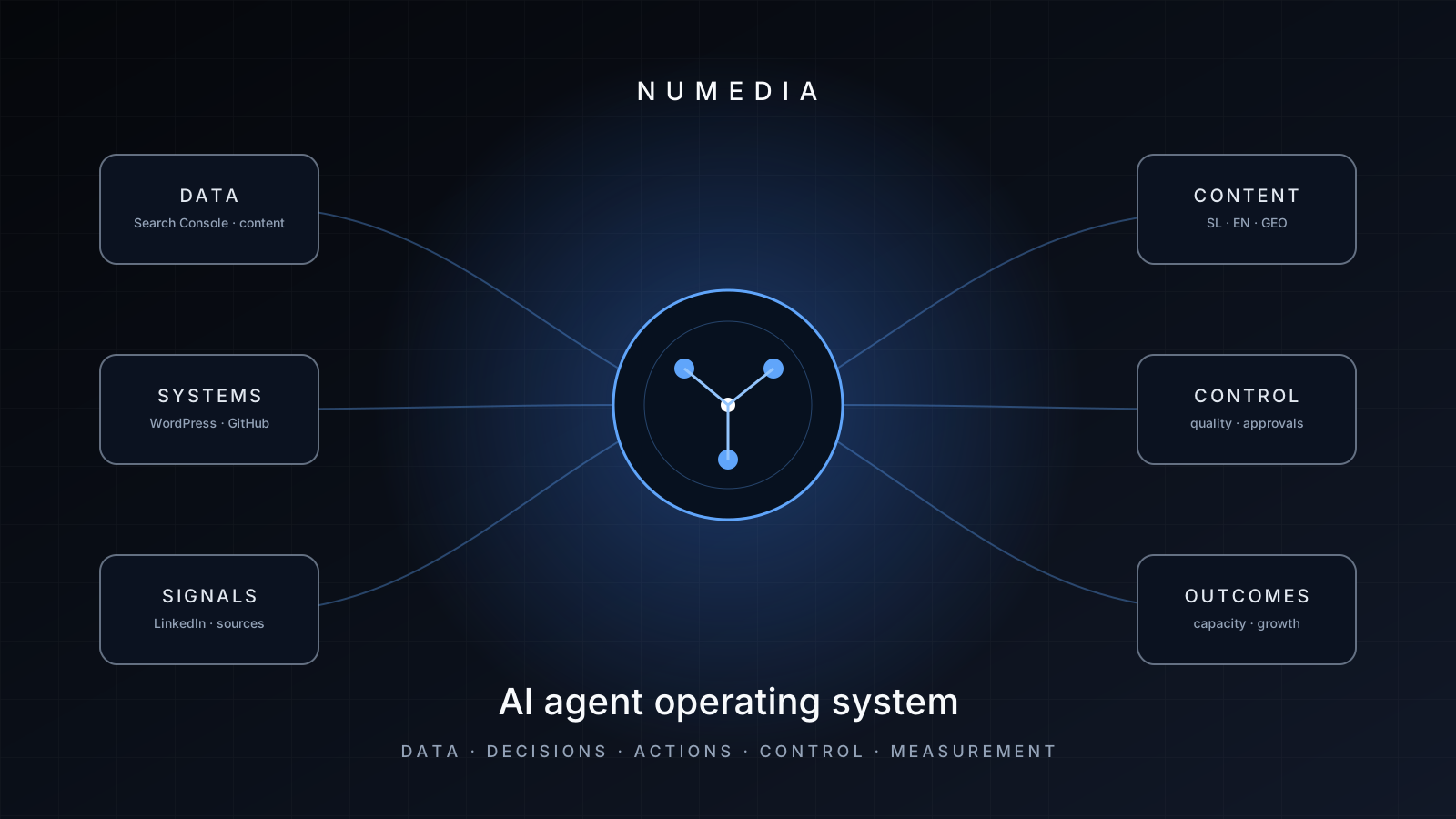
We divided the system into five layers so that data, decisions and permissions remain visible. This makes individual agents easier to test and prevents a fluent output from being mistaken for a reliable business process.
- Data: live pages, content inventory, Search Console, publication history, social schedules, code structure and primary sources.
- Decision: search intent, commercial relevance, cannibalization risk, evidence requirements and the best action type.
- Execution: a restricted toolset for WordPress, GitHub pull requests or LinkedIn scheduling.
- Quality and safety: verified links, sources, claims, URLs, language, structured data, rate limits and human approval where impact is higher.
- Reporting: selected action, rationale, source data, target query, quality gate results and the next opportunity.
Agent 1: daily growth for geooptimizacija.si
geooptimizacija.si has a specialist role: it is designed to become a leading Slovenian educational and commercial resource for generative engine optimization. numedia.si carries the wider agency proposition. Keeping those roles distinct reduces overlap between two domains that could otherwise compete for the same intent.
The GEO agent runs daily. It first reviews current WordPress content, then compares Search Console data across 28-day and 90-day windows. It looks at queries, pages, impressions, clicks, click-through rate, average position, ranking movement, content decay, cannibalization and opportunities sitting just below the first page.
The agent chooses one action with the highest expected effect. It may improve an existing page, create a genuinely missing page or deliberately publish nothing. New posts are capped at three in any rolling seven-day period. The objective is topical authority and commercial usefulness, not synthetic activity.
Before direct publication it verifies sources, internal and external links, the H1, slug, numbers, dates and the consistency of visible content and structured data. It may not invent results, clients, certifications, quotes, prices or guaranteed visibility in any AI system.
Agent 2: bilingual SEO production for numedia.si
NUMEDIA covers a broader set of commercial themes, including AI revenue systems, agent infrastructure, performance marketing, websites, ecommerce, SEO and business transformation. The NUMEDIA content agent therefore selects topics that complement the agency proposition instead of duplicating deep specialist GEO coverage.
Twice a week it prepares a Slovenian and an English content pair. The English page is editorially localized, not mechanically translated. It receives its own title, slug, intent, calls to action and language-appropriate internal links.
Each execution works on a separate Git branch. The agent adds both pages, routes, reciprocal hreflang, self-referencing canonicals, metadata, an accessible hero asset, sources, related content and a publication log entry. It then runs linting, tests and the production build before opening a pull request. The production change remains reviewable and reversible.
Agent 3: LinkedIn as a distribution system
The third agent supports the NUMEDIA LinkedIn page three times a week. Before drafting, it reviews recent and scheduled posts, available LinkedIn analytics, new content from both domains and relevant Search Console signals.
It does not compress an article into a generic social post. It creates an original angle with a strong opening, short paragraphs, specific value and a natural close. When the post refers to an article, the agent must verify and use the actual canonical URL.
Sales intensity is limited. No more than one of the last three posts may use a strong commercial call to action. If the agent cannot find a fresh and verifiable angle, it skips the run. Distribution remains a system for expertise and trust, not an automated stream of advertisements.
Search Console and Google Analytics 4 answer different questions
Google Search Console explains how a website performs in Google Search: queries, impressions, clicks, click-through rate, positions, pages, devices and countries. Google Analytics 4 explains what happens after a visitor arrives: sessions, engagement, events, journeys and, when configured correctly, conversions and revenue.
Google's own guidance treats Search Console as the source of truth for search performance and Analytics as the source of truth for on-site behavior. Similar-looking metrics such as clicks and sessions do not necessarily match because the systems measure different events under different rules.
At the cut-off date, Search Console was connected for both domains. GA4 was not yet connected to the agent environment. We therefore do not claim that the system already measures behavior, enquiries, conversions or revenue.
The next phase is to connect GA4, validate key events and conversion definitions, and relate landing pages to search demand. Only then can the measurement chain be closed from search impression to click, visit, action, qualified enquiry and sale.
Autonomy follows the consequence of an error
Giving every task the same level of autonomy is a design mistake. Publishing a reversible social post, changing production code and redefining a conversion event do not carry the same risk.
We assign autonomy according to impact, reversibility and the quality of available controls. Low-risk analysis can run independently. Production code remains behind a pull request. Measurement changes, sensitive claims and critical system decisions require explicit human approval.
| Action | Autonomy | Control |
|---|---|---|
| Search Console analysis | Independent | Agent records source, period and limitations |
| Opportunity selection | Bounded independence | Intent, cannibalization and commercial relevance checks |
| WordPress content update | Conditional independence | Quality gates and URL preservation |
| New WordPress article | Conditional independence | Rate limit, verified sources, links and call to action |
| numedia.si code change | Pull request | Tests, build and human approval before merge |
| LinkedIn post | Independent in one channel | Novelty, URL, facts and sales intensity checks |
| Analytics or conversion changes | Human approval | Event and attribution validation first |
| Critical system change | No independent execution | Security review, explicit approval and rollback |
How long implementation took
The first operating phase was built between 15 and 18 September 2026, four calendar days. The hours below are a retrospective estimate based on completed work, not a minute-by-minute billing record.
This speed should not be read as a universal promise. NUMEDIA already had two websites, accounts, basic analytics, a content plan and technical infrastructure. A client implementation may take longer because of legacy systems, permissions, data quality, missing APIs, security requirements or additional testing.
| Implementation work | Estimated time |
|---|---|
| Business goals, domain roles and success criteria | 4 hours |
| Access, content, Search Console, WordPress and GitHub review | 5 hours |
| Agent instructions, decision rules, limits and quality gates | 8 hours |
| WordPress and GitHub publishing workflows | 6 hours |
| LinkedIn research and publishing workflow | 3 hours |
| Testing, first runs, corrections and reporting structure | 6 hours |
| Total | 32 hours |
The monthly capacity model
We estimated savings from the bottom up. First we defined the expected monthly workload at the agents' current cadence. We then compared the time an experienced marketing specialist would need for the same level of research, technical preparation and documentation with the human time that remains for judgment, corrections and approval.
The public summary rounds the result to 80 to 105 hours per month. Against a 168-hour working month, this represents about 48 to 63 percent of one employee's capacity.
At a fully loaded monthly employee cost of EUR 3,200, one working hour in this example is worth EUR 19.05. Eighty hours represent approximately EUR 1,524 of monthly capacity; 105 hours represent approximately EUR 2,000.
The annual gross capacity value is therefore approximately EUR 18,300 to EUR 24,000 per employee. The calculation does not include model usage, integration tools, monitoring or maintenance, so it should not be presented as net savings.
Economic value appears when the company can delay a hire, reduce outside spend, increase valuable output or redirect the released time into revenue-generating work. The correct formula is released capacity plus incremental value, minus tools, maintenance and human oversight.
| Monthly workstream | Manual process | Agent-supported process | Capacity released |
|---|---|---|---|
| Search Console analysis and prioritization | 18 to 24 h | 5 to 7 h | 13 to 17 h |
| Research, source verification and briefs | 20 to 28 h | 6 to 9 h | 14 to 19 h |
| Content, localization and technical publishing | 44 to 60 h | 15 to 20 h | 29 to 40 h |
| LinkedIn research, writing and scheduling | 18 to 24 h | 4 to 6 h | 14 to 18 h |
| Reporting and execution logs | 12 to 16 h | 3 to 5 h | 9 to 11 h |
| Total | 112 to 152 h | 33 to 47 h | 79 to 105 h |
What changed, and what we do not claim
The system was only days old at the cut-off date, so this case study does not claim a proven increase in organic rankings, enquiries or revenue. Those outcomes require a longer observation period and validated conversion analytics.
What we can document is the operating change: two Search Console properties are connected; three recurring agents have clear responsibilities; publication channels have explicit permissions and stop conditions; higher-risk code changes remain reviewable; and every run produces an evidence trail.
The system explicitly prohibits invented results, statistics, links, case studies and ranking promises. GA4 is labelled as a next phase rather than presented as an active source of conversion evidence.
- Daily data-led GEO cycle for geooptimizacija.si
- Twice-weekly bilingual content cycle for numedia.si
- Three-times-weekly LinkedIn distribution cycle
- Defined tools, actions, exclusions and escalation paths
- Human review for production code and measurement changes
- Structured run reports with decision, evidence, action and next opportunity
What we will measure in the first 90 days
Operational metrics include successful run rate, skipped publications caused by quality gates, human review time, corrections before approval, duplicate topics, broken links and failed technical checks. These show whether an agent is reliable, not merely active.
Search metrics include relevant impressions, clicks, click-through rate, positions, new queries, near-page-one opportunities, decay and cannibalization. Brand and non-brand demand will be separated, as will informational and commercial intent.
LinkedIn measurement will focus on reach, quality of interaction, clicks to canonical content and topic repetition. After GA4 is connected and validated, we will add landing pages, engaged sessions, key events, enquiries and conversion journeys.
The final business measures are qualified enquiries, sales meetings, opportunity value, won projects and revenue. An agent that creates a large content volume without influencing the business objective is not a successful agent.
Seven lessons for companies introducing AI agents
The first production use case should be selected for clarity and measurable value, not for spectacle. Our implementation produced seven practical rules.
- Start with the business outcome, then choose the model and tools.
- Give each agent one clear responsibility and owner.
- Define which data source is authoritative for each question.
- Give the agent permission to take no action when evidence is weak.
- Increase autonomy according to the consequence and reversibility of an error.
- Require reports to explain decisions, evidence and quality gate results.
- Measure quality and business outcomes, not time saved in isolation.
Why NUMEDIA's approach is different
NUMEDIA does not treat an AI agent as an isolated chatbot or a content generator. We connect strategy, web development, data, SEO, GEO optimization, distribution, permissions, evaluations and business measurement.
Our internal case demonstrates three capabilities. We can decompose a real marketing process into data, decisions and responsibilities. We can connect agents to production systems such as WordPress, GitHub, Search Console, Analytics and social channels. We can also define the boundary where autonomy ends and accountable human judgment begins.
The result is not a count of automations. It is an operating system that can be used, measured, audited, improved and safely rolled back.
How NUMEDIA implements an AI agent in a business
We begin with the process. We document inputs, manual steps, systems, owners, cycle time, exceptions and the business outcome. We then estimate opportunity size, feasibility and risk. The process with the most manual work is not always the best first candidate.
Next we design agent instructions, data sources, permitted actions, prohibitions, human approvals, reporting, evaluation cases and a safe shutdown path. A bounded pilot must prove task quality and released capacity on real work.
Only after the pilot meets its thresholds do we increase frequency, scope or autonomy. Every added capability has an owner, a measure and a rollback path.
Conclusion
AI agent implementation is the design of a new operating layer that connects data, judgment, action, control and measurement. In four days, NUMEDIA built the first working version on its own marketing operation.
The central result is not the number of automated posts. It is a system that starts with current data, chooses the most useful permitted action, rejects weak tasks, respects its permissions and explains what it did.
For organizations considering agents in marketing, sales, support, reporting or internal knowledge, the best next step is a clearly defined business case and a controlled first production workflow.
Sources and methodology
- A practical guide to building AI agents (OpenAI, accessed 18 September 2026)
- Using Search Console and Google Analytics data for SEO (Google Search Central, accessed 18 September 2026)
- Google Search Console (Google, accessed 18 September 2026)
- Google Analytics (Google Marketing Platform, accessed 18 September 2026)
- AI Risk Management Framework (NIST, accessed 18 September 2026)
Frequently asked questions
What is an AI agent for business?
It is a system that can use current data and approved tools to complete multiple steps toward a business goal within defined instructions, permissions and controls.
How long does AI agent implementation take?
NUMEDIA's first internal phase took four calendar days and an estimated 32 hours of active work because the underlying websites, accounts and technical infrastructure already existed. A client pilot is usually planned in weeks.
How much time can an AI agent save?
Our marketing, SEO, GEO, analytics, LinkedIn and reporting model estimates 80 to 105 hours of released capacity per month. The actual result depends on workload, data quality, autonomy and review effort.
Does an AI agent replace an employee?
Our objective is to move human time from repetitive research, preparation, publishing and reporting into strategy, judgment, relationships and quality control.
Can an AI agent publish directly to a website?
Yes, for bounded and reversible actions behind verified quality gates. Higher-impact production code changes remain in a pull request until a human approves them.
Why are both Search Console and Google Analytics needed?
Search Console measures search visibility and clicks. Analytics measures on-site behavior, events and conversions. Together they connect discovery with business outcomes, but their metrics should not be treated as identical.
What is the difference between automation and an AI agent?
Automation follows a predefined sequence. An agent can select the best permitted sequence for the current data, which requires stronger controls, evaluations and monitoring.
How should a company choose its first agent workflow?
Choose a repeatable process with a clear outcome, usable data, measurable cost or delay and acceptable failure consequences. Avoid a first use case with unclear rules or irreversible risk.