AI in business operations · 8 min read
AI product data quality: reconcile your ERP and ecommerce catalog
The ERP states one volume, the description another and the image shows a different variant. Customers experience this as an unclear offer rather than a data problem. An AI agent could compare agreed sources, identify discrepancies and prepare evidence-backed correction proposals. The useful output is a queue of specific decisions for the catalog owner.
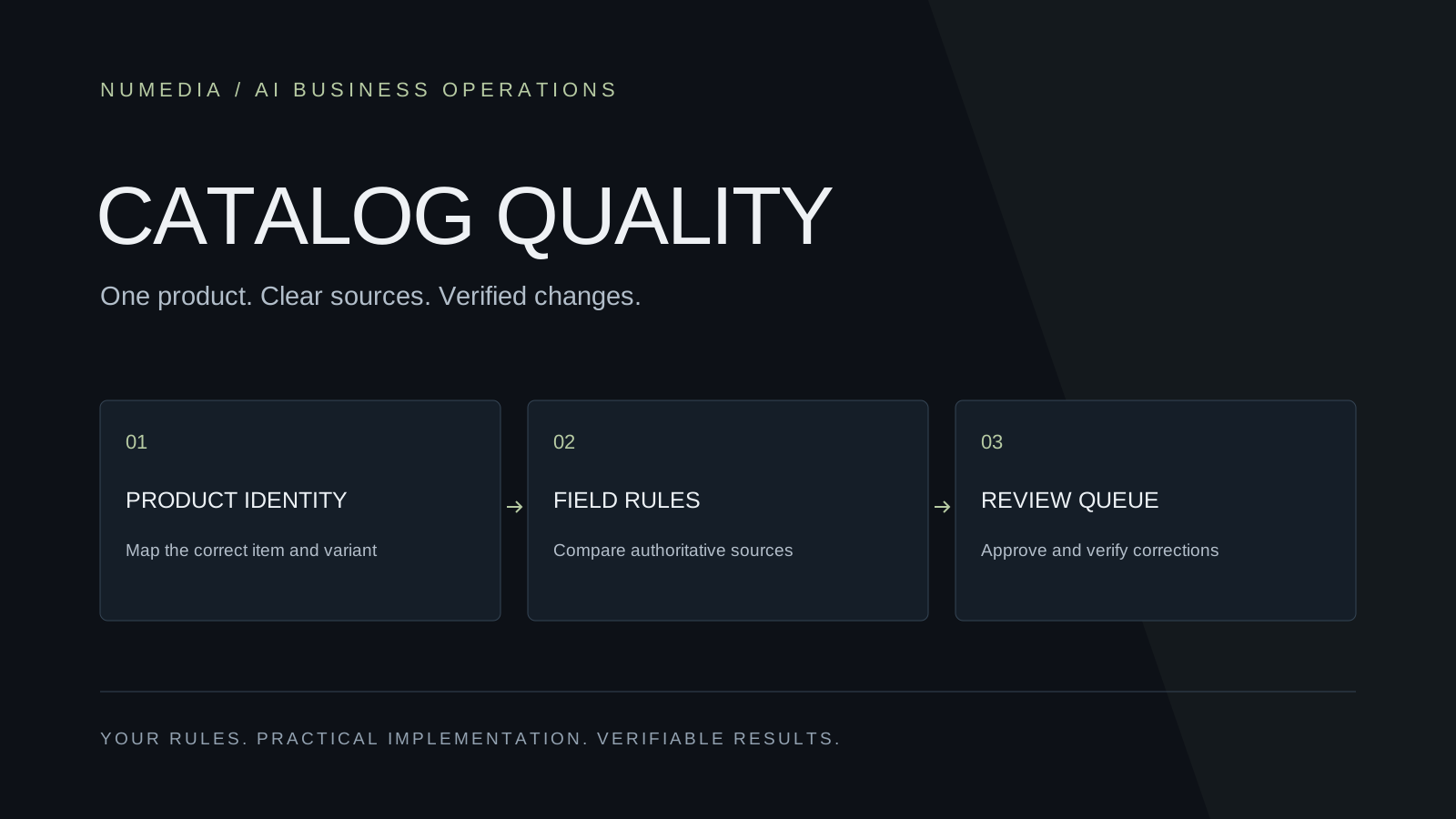
Your catalog needs reliable facts before it needs more copy
NUMEDIA would scope the first project around a selected product group and important fields. The examples are hypothetical, not findings about an actual store or promises of sales uplift. This guide addresses operational data quality between systems and shows how that control could fit your catalog team’s work.
A worked example: equivalent notation or the wrong variant?
An ERP value of 0.75 l and a store value of 750 ml may describe the same quantity. After correct normalization, this is not a factual discrepancy. If the selected variant’s title states 500 ml, however, that raises a different issue. The agent should show the variant being compared and preserve the original values.
Comparison therefore needs correct identity, variant mapping and agreed conversions. Bundles introduce the quantity of individual units too. One system may describe an item while another describes a set. A correction proposal should explain that distinction rather than choose the most common value without justification.
A source-of-truth template for individual fields
Define the authoritative source field by field. The ERP is not necessarily the authority for every marketing statement, and the storefront is not automatically the source of product identity. Assign each rule an owner and review method. This is NUMEDIA’s working template to adapt to your catalog.
| Field | Agreed source | Pre-change check |
|---|---|---|
| Identity and variant | Approved catalog and identifier mapping | Are these the same variant |
| Dimensions or content | Confirmed technical specification | Unit, conversion and value meaning |
| Price and availability | Authorized operational source | Timestamp and current sales rules |
| Description | Approved attributes and editorial template | Does the copy introduce unsupported claims |
| Image | Confirmed product or variant association | Does it show the correct option |
| GTIN | Confirmed trade-item identity | Correct association; never invent a missing identifier |
Products, variants and trade-item identifiers are distinct
Shopify documents a variant as a separate object associated with its parent product. GS1’s GTIN standard addresses consistent identification of trade items. Applied to this proposed comparison, similar product names must not simply be merged. Identity mapping needs enough precision for the field and business purpose being checked.
NUMEDIA would document identifier mapping with your team. Multiple candidates lead to review. Missing identifiers must not be filled with invented numbers. Even a correctly formatted identifier does not establish that it belongs to the record in question. The connection needs a confirmed source.
Decide what needs review before publication
Discrepancies have different consequences. An incorrect content quantity or variant can change the understood offer; a style inconsistency needs another priority. Your team decides which fields require review before publication and which can remain in an editorial queue. Rules should be explicit rather than hidden inside a model’s score.
| Finding | Next action | Reviewer |
|---|---|---|
| Wrong variant mapping | Hold the proposed change and identify the product | Catalog owner |
| Equivalent unit notation | Normalize using an approved rule | Data-rule owner |
| Conflicting specification | Inspect the original technical source | Product specialist |
| Unsupported description claim | Editorial review with evidence | Content owner |
| Stale operational value | Retrieve again from the authorized source | Integration owner |
Draft descriptions from confirmed facts
Once attributes are verified, AI can help draft a clearer description or localized version. The proposal should remain within approved information. It must not introduce ingredients, compatibility or certification simply because similar products often have them. Copy preparation and fact acceptance remain separate stages.
Google’s product data specification identifies missing or conflicting attributes and discrepancies between data sources and websites. For this proposal, that supports the importance of reliable source information. The guide does not repeat Shopping feed optimization: it addresses the upstream process for preparing and checking catalog data before distribution to sales channels.
Version proposals and recheck before writing
A proposal is based on a particular snapshot. If an employee updates the product meanwhile, an older proposal must not overwrite the new information without review. Compare current state with the state used to prepare the suggestion. A difference may require renewed review, especially for price, availability or variants.
Retain the previous value, proposal, reason, evidence and review decision. After writing, verify the destination result. Following an ambiguous connection failure, establish whether the change already happened before retrying. The first scope would use reviewed proposals; automatic writes would be introduced only for separately agreed cases.
Test both known errors and correct records
The test set should include equivalent units, similarly named variants, bundles, stale data and missing identifiers. The agent must detect important differences without generating excessive false alerts. A catalog owner forced to approve every harmless notation difference will struggle to use the workflow effectively.
Measure accepted findings, missed errors in a reviewed sample, handling effort and recurring issues. Separate results by field type. A catalog-wide average can hide poor variant mapping. Pilot acceptance should focus on the attributes that actually matter for your products and the work needed to correct them.
A first NUMEDIA project: one group and a defined output
The proposed scope covers source assessment, product mapping, selected field rules and a review queue. It would include correction proposals, test cases and operating instructions. Where writing changes is included, assess interfaces and authority before implementation. First establish a traceable view of what the system proposes to change.
Your team contributes a representative export, source definitions and people able to validate correct values. Choose a group with sufficient variants and known issues. The proposal separates source-data preparation, integrations, checks and ongoing operation, giving you a concrete basis for assessing the engagement.
Show us the information your team keeps correcting
Write “AI product data quality” in the contact form. Name your ERP, ecommerce platform and two or three recurring errors. A record of the same product in both systems, with the correct value identified, is a useful starting input. NUMEDIA can then scope an achievable first workflow.
Use the checklist to prepare the discussion. Any eventual sales effect should be evaluated separately; every corrected field cannot be assumed to increase conversions. The first measurable benefit may be less repeated reconciliation and a more dependable foundation for catalog work.
- Product-code and variant mapping between systems
- An owner for each selected field rule
- A known error and a correct unit conversion
- Agreed review, write and destination-verification steps
Sources and methodology
- ProductVariant: GraphQL Admin API (Shopify, accessed 2026-10-26)
- GTIN Management Standard (GS1, accessed 2026-10-26)
- Product data specification (Google, accessed 2026-10-26)
Frequently asked questions
Will AI automatically change prices and stock?
The initial proposal prepares findings and suggestions for review. Operational changes require specific rules, authority and result verification.
Is matching by product name sufficient?
Names can help find candidates but do not establish identity. Use mapped product codes, variants and other confirmed identifiers where needed.
What happens to a missing GTIN?
Flag it for review against an authoritative source. The agent must not invent identifiers or infer product identity solely from a valid-looking number.
Is this the same as Shopping feed optimization?
This project addresses upstream operational data quality between ERP and store. Reliable information can support feeds, but source mapping and corrections are the primary purpose.