AI in business operations · 8 min read
AI service requests: from customer report to a usable work order
A customer reports a problem. A dispatcher searches for the correct asset, location, previous visit and contact. Missing information may later be searched for again by the technician. An AI agent could prepare a work-order draft from the request, link available records and identify gaps. The business output is a usable case for planning and execution.
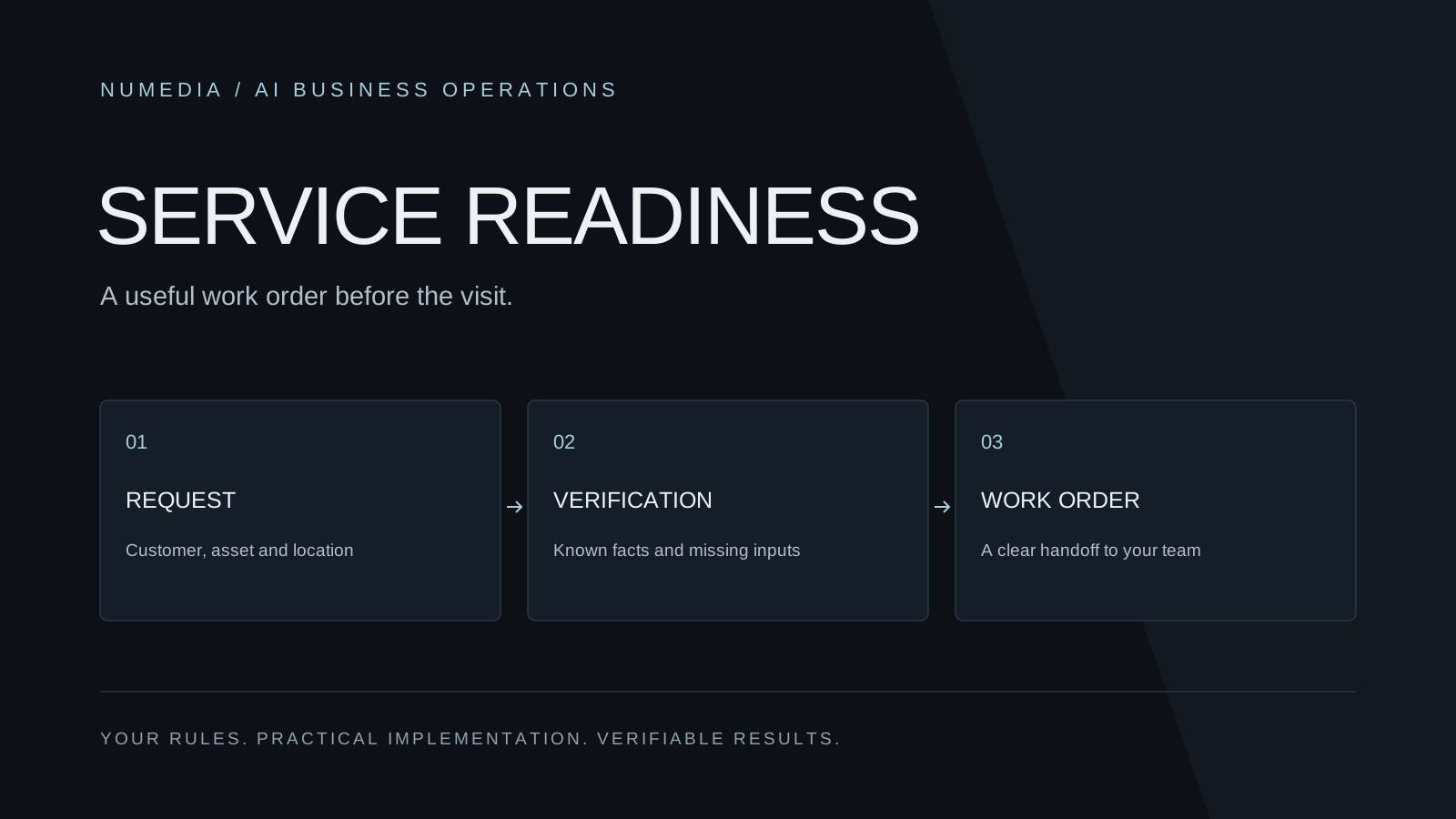
Technicians need a usable work order before the visit
NUMEDIA would scope the first project around a selected service request type and your existing environment. The hypothetical example below illustrates implementation rather than client results. It is intended for teams seeking less preparatory administration and a clearer handoff between intake, dispatch and field staff.
A worked example: similar equipment at different locations
The customer reports that “the unit near the warehouse is not working.” Their record contains two similar units at different addresses. The agent can summarize the request and suggest possible matches, but cannot establish the correct asset by guessing. Identification becomes a specific review task. Once confirmed, the right service history can be attached.
This keeps a polished summary from creating a false impression of readiness. Separate what the customer reported, what records show and what the team verified. A problem description remains a description. Diagnosis, required parts and suitability of the intervention are confirmed by the responsible specialist through your operating process.
A work-order template you can test immediately
Apply the table to a recent request. It distinguishes available information, record-derived context and checks still needed from a person. The agent would prepare this package with source references. Your service lead defines mandatory fields for the selected work type.
| Field | Required content | Missing-data response |
|---|---|---|
| Customer and contact | Confirmed record and coordination contact | Assign case identification |
| Asset and location | Equipment identifier and actual address | Do not guess between similar assets |
| Reported issue | Summary linked to the request | Flag unclear descriptions |
| History | Relevant confirmed previous work | Show when a connection is missing |
| Visit preparation | Required capabilities and open questions | Specialist review |
| Next step | Owner, state and transition condition | Keep the case in a visible queue |
Request state and an appointment are different records
A complete request does not establish a booked visit. A scheduling proposal needs appropriate availability, team suitability, location and work-preparation information. An appointment becomes confirmed through the accountable person or agreed system. Finding an empty calendar slot alone should not create a customer commitment.
Microsoft’s Field Service documentation distinguishes work-order states from booking states. NUMEDIA would translate this principle into your rules: when a case is ready for scheduling, when it has a confirmed allocation and who accepts completion. The actual labels follow your environment rather than collapsing different milestones into one resolved status.
Which connections we would assess
The source could be your existing service portal or case system. We would assess links to asset records, confirmed service history and planning tools. Microsoft’s work-order guide illustrates coordination of work, resources and activities. It is an organizational example; the implementation choice depends on the tools you already operate.
NUMEDIA would check interfaces, identifiers and record quality first. The initial output could be a draft in your system or an agreed review package. Replacing software is not an automatic prerequisite. If asset records need work, prepare a representative subset before automating the workflow. Otherwise the project may simply accelerate searching through ambiguous records.
Give exceptions an owner and a reason
Requests can repeat, customers can change locations and new information can arrive during review. Preserve case identity and show what changed. A repeated report does not automatically require another visit. Nor does cancelling an appointment prove the underlying request is closed.
Define routes for unknown equipment, incomplete information, failed connections and out-of-scope cases. The employee taking over needs the reason and completed checks. Forwarding the original unorganized text does little to improve the handoff. A useful output reduces continuation effort even when manual review is required.
A starter acceptance-test matrix
Test the complete route, not only summary quality. Every case needs an expected outcome, accountable owner and destination evidence. Anthropic distinguishes predefined workflows from dynamically chosen steps. Here, required fields and permitted transitions would follow explicit rules, while AI helps interpret differently written requests.
| Case | Expected result |
|---|---|
| Complete request for a known asset | Correct draft linked to the right records |
| Two similar assets | Visible ambiguity and identification task |
| Repeated request | Connection to the existing case without another visit |
| Cancelled appointment | Booking change without loss of the request |
| Interruption after a write request | Verify destination state before retrying |
Measure readiness and total team effort
Establish how much active intake and dispatch work is needed to prepare a usable order. Separate this from waiting for customers or available staff. After implementation, count review, completion and correction effort. Faster drafting alone does not demonstrate a shorter end-to-end process.
Useful measures include orders accepted without further information searches, repeated questions and time to scheduling readiness. Track reasons a case returns for completion. Changes in first-visit outcomes need separate assessment because expertise, equipment and conditions at the customer also affect them. They cannot automatically be attributed to the agent.
What a NUMEDIA implementation would include
The proposed first scope covers one request type, a work-order template, agreed source connections, exception review and record verification. It would include user instructions and interruption handling. Your team defines priority rules, planning prerequisites and accountable owners. The project organizes service work rather than replacing technical execution with generated text.
The proposal would separate data preparation, initial integrations, workflow implementation and continuing maintenance. Anonymized requests and accepted work orders are useful starting inputs. Include difficult examples as well as routine ones. This lets you assess a specific engagement rather than an undefined promise of AI for service.
Show us where your service handoff stops
Write “AI service requests” in the contact form. Name your service tool, asset-record system and the most frequent reason orders return for clarification. NUMEDIA can define a feasible first workflow with a clear output, connections and acceptance criteria.
Review the checklist before the discussion. Missing prerequisites can become preparation work. A good initial process is one where the team can demonstrate an acceptable work order and identify who authorizes its next stage.
- One defined service request type
- A link between customer, equipment and location
- An accepted order and typical clarification examples
- Owners for preparation, planning and acceptance rules
Sources and methodology
- Create a work order (Microsoft, accessed 2026-10-26)
- Work order lifecycle and system statuses (Microsoft, accessed 2026-10-26)
- Building effective agents (Anthropic, accessed 2026-10-26)
Frequently asked questions
Will the agent diagnose equipment faults?
This initial proposal prepares and validates information for the work order. The responsible specialist confirms diagnosis and intervention suitability through your process.
Do we need new service software?
We first assess current interfaces and working practices. Drafts could appear in your system or an agreed review format.
Will it confirm appointments automatically?
This proposal prepares the basis for scheduling. Confirmation follows your rules, availability and internal authority.
What is needed for a proposal?
Sample requests, accepted orders, the tools involved and your asset-to-location mapping. Scope follows review of actual data and exceptions.