AI in business operations · 8 min read
AI supplier quote comparison: from PDFs to a reviewable decision
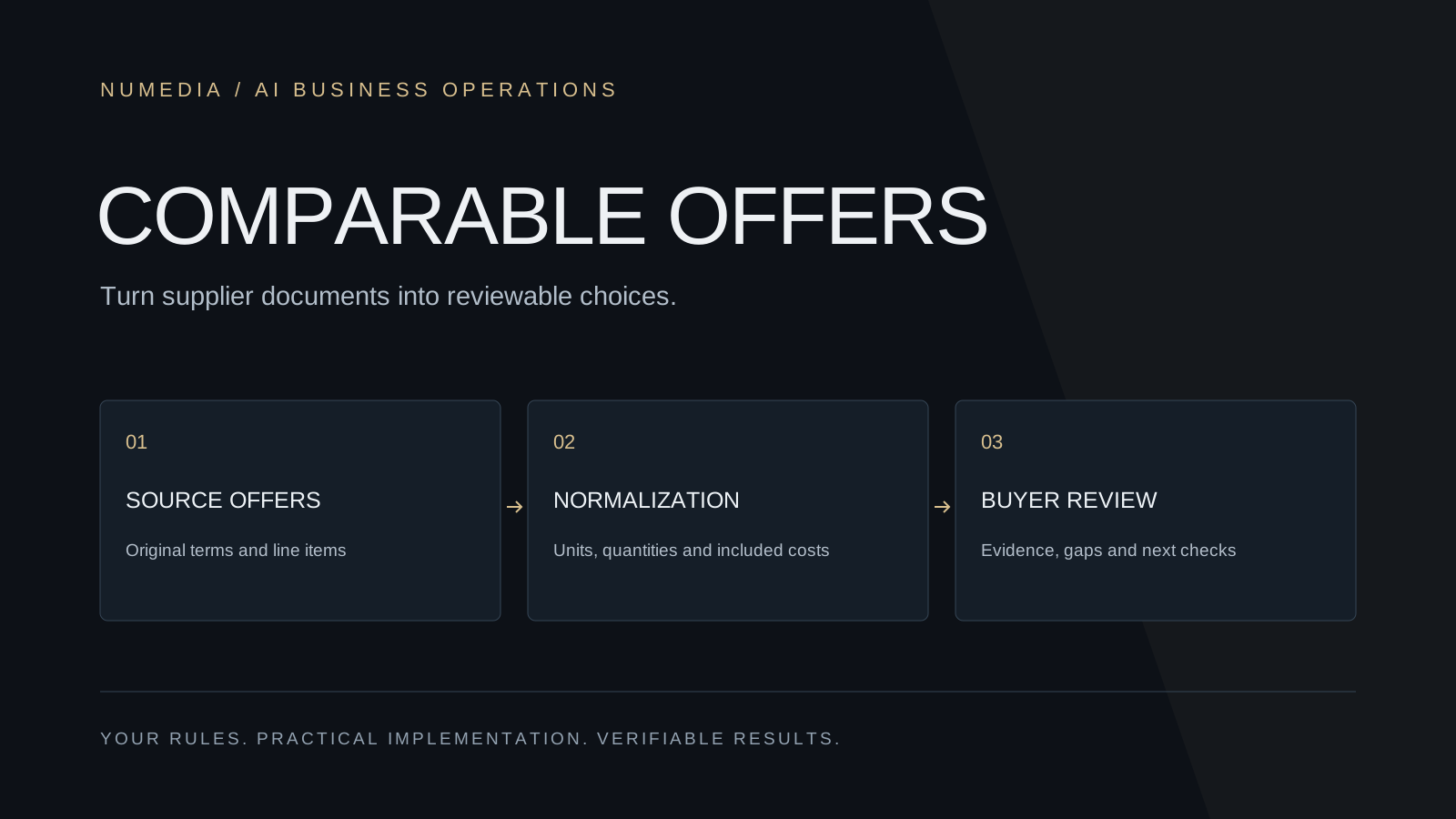
One supplier quotes per item, another per pack and a third omits delivery. A buyer first copies the offers into a spreadsheet before substantive comparison begins. An AI agent could organize line items, sources and visible differences. A useful output is a verifiable comparison with unresolved questions and the next checks needed.
The lowest stated price does not establish the best fit
NUMEDIA would begin with one recurring purchasing category and your comparison rules. The following offers A and B are hypothetical. They are not real suppliers, market prices or measured savings. The working example helps define what should be extracted and which conditions your team needs to confirm before deciding.
Define the requirement before comparing documents
Establish the required product, version, quantity and mandatory conditions. Similar names do not prove technical equivalence. If alternatives are allowed, specify which attributes make them acceptable. The agent can suggest line-item matches while an accountable reviewer confirms that the options are comparable.
Maurya and colleagues’ 2020 research examines matching differently written invoice and purchase-order descriptions. It illustrates the matching problem rather than prove a current agent’s performance on your quotations. For this proposed workflow, the practical implication is to retain original descriptions and evidence supporting each suggested match.
A quotation-extraction template
Complete the matrix with your buyer. Every value needs its source, transformation rule and missing-data response. Unmentioned delivery must not become free delivery. Unclear validity is an open question. The comparison should reveal what still prevents a decision.
| Information | What to retain | Required check |
|---|---|---|
| Product | Original description and proposed specification match | Version, composition and equivalence |
| Quantity | Number and separate unit or pack size | Minimum order and order multiples |
| Price | Amount, currency and charging basis | Included items and comparable tax treatment |
| Delivery | Freight, destination and stated lead time | Inclusions and when timing begins |
| Validity | Offer date and version | Whether it remains valid |
| Gap | Missing condition with an owner | Whether clarification is required before deciding |
An illustrative calculation for one hundred items
Assume equivalent products, the same currency, consistent tax treatment and confirmed availability. A quotes €9.80 per item plus €60 delivery. B quotes €105 for a pack of ten with delivery included. For one hundred items, A totals €1,040 and B €1,050. All figures are illustrative assumptions.
The €10 difference does not finish the selection. Lead time, suitability and other mandatory conditions still need confirmation. Differences in those assumptions remain visible. An incomplete offer can be prepared for clarification without substituting a favorable assumption for an unknown value.
| Basis: 100 items | Offer A | Offer B |
|---|---|---|
| Price and unit | €9.80 / item | €105 / pack of 10 |
| Required quantity | 100 items | 10 packs |
| Goods | €980 | €1,050 |
| Delivery | €60 | Included |
| Comparable amount | €1,040 | €1,050 |
Separate calculation from explanation
Quantities, prices and conversions should follow defined rules. The model helps interpret document text and explain differences. Each calculated figure needs visible inputs and a formula so the buyer can inspect the comparison rather than trust a final narrative.
Microsoft documents document text and table extraction, while Anthropic emphasizes well-designed agent tools. NUMEDIA would combine such components with your checks. A readable extracted table is not yet an accepted purchasing comparison. Documents that cannot be interpreted reliably need a clear route for manual completion.
Avoid precision that hides unresolved conditions
Test mandatory conditions before ranking offers. An unacceptable option does not become suitable because it scores well elsewhere. If your process uses weights, your team defines and explains them. The agent should not invent weights and present the resulting selection as an objective assessment.
For a close comparison, identify the assumption that could change the outcome. Does another quantity change the price? Is delivery confirmed? Is the version equivalent? These questions can be more useful than a single aggregate score hiding inconsistent conditions. Your accountable buyer approves the final selection and order.
Keep revised offers identifiable
A supplier may send a changed price or lead time after clarification. The comparison must show the current version and what changed. Replacing a document must not silently retain an obsolete delivery charge or minimum quantity. Values should remain linked to a specific quotation, line item and verification time.
The initial workflow would prepare a comparison and clarification list. Sending questions or creating an order is a separate capability governed by your rules. If recording results in business software is included, verify destination records and handle duplicates. The process should remain understandable after repeated offers or connection interruptions.
Acceptance tests for the first deployment
Include different units, unclear freight, non-equivalent products and revised documents. Each comparison should retain source values, correct transformations and visible gaps. Review complete line items: an incorrectly matched product can invalidate an otherwise accurately extracted table.
Measure time to a reviewed comparison, correction effort and the usefulness of supplier questions. Count the buyer’s entire task rather than generation time alone. Lower purchasing prices cannot automatically be attributed to the agent because negotiations, volume and markets also matter. The first benefit may be more consistent preparation of a decision.
What NUMEDIA would implement
The proposed project covers one category’s comparison schema, document intake, line-item mapping, verifiable calculations and exception review. It would include test cases and version-handling instructions. Any connection to existing business software is assessed before the scope is confirmed.
Your team contributes sample offers, the requested specification and an accepted comparison. It also defines mandatory conditions and the person authorized to confirm equivalence. Starting with every purchasing category is unnecessary. A repeatable group with a clear definition of a useful outcome is a stronger initial scope.
Show us two offers your team compares manually
Write “AI supplier quote comparison” in the contact form. Describe the category, current comparison tool and main preparation problem. Two anonymized examples and the expected output provide a practical starting point. NUMEDIA can then scope a feasible workflow and acceptance criteria.
Review the conditions below. Where item equivalence depends on experience, incorporate that expertise into the review rules. The aim is to retain useful purchasing judgment while reducing repetitive collection and organization of information.
- An approved requirement and comparable units
- Rules for freight, currency and included costs
- An owner for technical-equivalence decisions
- An accepted comparison and an incomplete offer
Sources and methodology
- Document Intelligence layout model (Microsoft, accessed 2026-10-26)
- Online Similarity Learning with Feedback for Invoice Line Item Matching (Maurya et al. / arXiv, accessed 2026-10-26)
- Writing effective tools for agents (Anthropic, accessed 2026-10-26)
Frequently asked questions
Will AI choose the supplier for us?
The proposed first scope prepares a verifiable comparison and open questions. Your accountable buyer approves the selection and order.
What if delivery cost is missing?
It remains unknown and is assigned for clarification. A missing cost is not a zero cost.
Can different pack sizes be compared?
Yes, when pack contents and product equivalence are confirmed. Conversions follow defined rules and original values remain visible.
What is needed for a first project?
Sample offers, the required specification, comparison rules and a purchasing reviewer. Scope follows document and exception assessment.