AI business workflows · 8 min read
AI client onboarding: from a won deal to a project ready to start
Sales confirms a new engagement. Delivery then discovers that essential information is missing. The customer answers more questions while a project manager searches for earlier agreements. An AI onboarding agent could organize this handoff: collect the approved scope, identify missing information and prepare tasks with accountable owners.
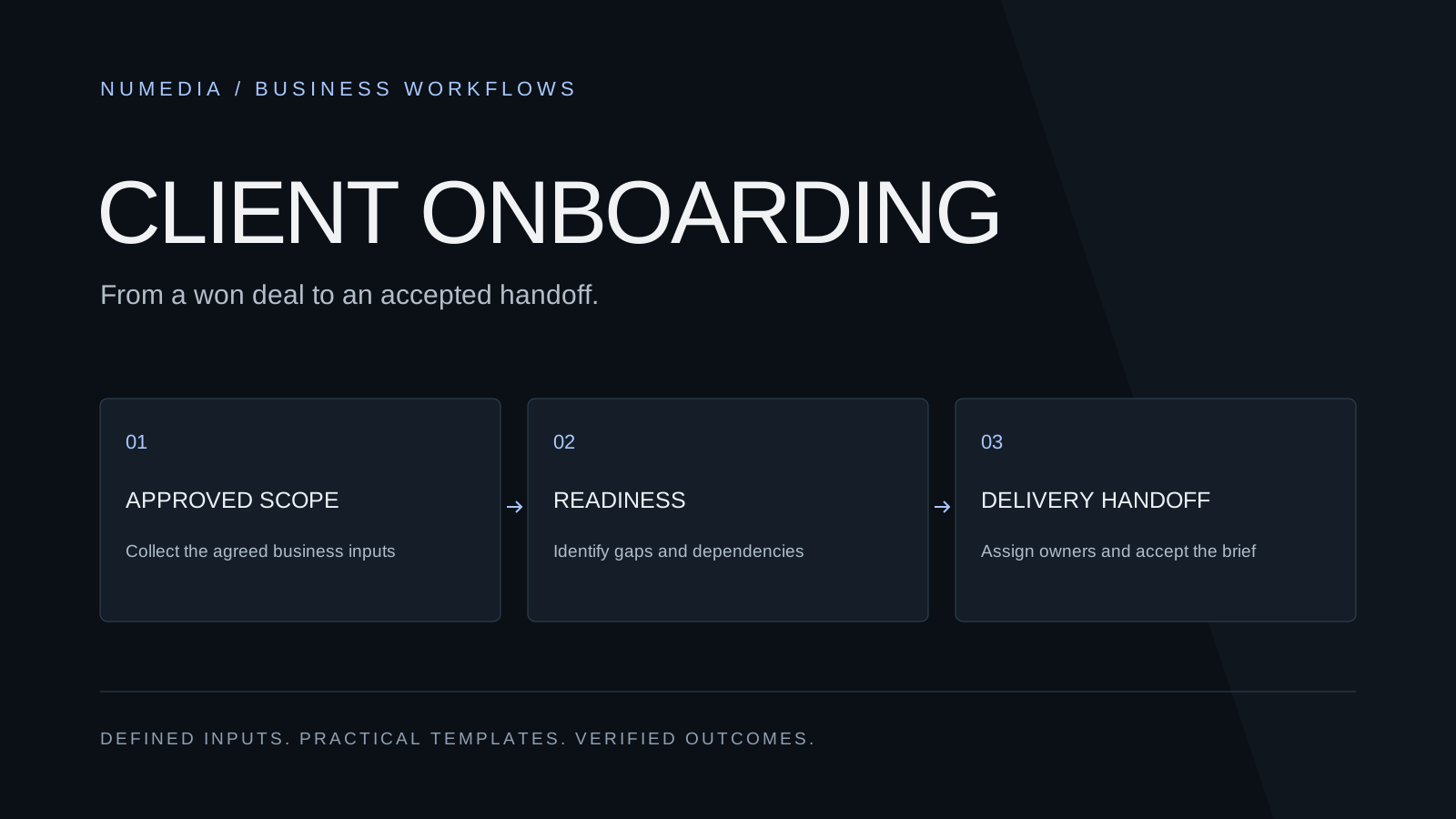
A won deal needs a well-organized beginning
NUMEDIA would design the first project around one service type. The hypothetical example below uses a company delivering digital projects. It is a proposed workflow rather than a report of client results. It shows how a confirmed deal can become an actionable delivery package and which decisions remain with your team.
Define what completes onboarding
Sending a welcome message is one activity. The initial workflow should finish when delivery accepts the package or records a specific obstacle. The package contains an approved objective, agreed outputs, missing inputs and assigned responsibilities. This provides a meaningful completion condition beyond the number of messages sent.
We would distinguish readiness for a kickoff meeting from readiness for execution. A meeting may require the business objective, while execution needs approved assets and access through an agreed route. Separate milestones prevent one missing input from blocking everything. Your team defines the conditions appropriate to its service.
A handoff brief you can use immediately
Fill in the template for a recently won deal. If nobody knows where a field’s answer lives, that identifies a real handoff gap. The agent could draft the package from approved sources and flag missing fields. A delivery owner confirms that it reflects the actual engagement.
| Field | Required content | Accountable reviewer |
|---|---|---|
| Business objective | What the client wants to achieve and how success is judged | Client owner |
| Approved outputs | What is included in the agreed scope | Sales or account owner |
| Open questions | Missing inputs with owners and next steps | Delivery lead |
| Dependencies | What each task needs before it can start | Task owner |
| Acceptance | Who accepts the package and authorizes the start | Project manager |
A worked example: missing assets need not block every task
A customer has commissioned a website redesign. The objective and scope are approved, but final photographs are missing. The agent could draft the brief, create an asset task and identify the activities that depend on it. A project manager decides whether information architecture can start. The entire project should not be assigned a simplistic ready-or-blocked state.
If a sales note mentions an extra feature absent from the approved scope, the agent must not silently create a new delivery obligation. It flags the difference for clarification. A date proposed in discussion is also different from a confirmed commitment. A useful handoff preserves the distinction between an agreement, a request and an unanswered question.
Fit the workflow into the environment your team already uses
A confirmed CRM deal stage could trigger the workflow. Its destination could be your project tool, task system or internal portal. HubSpot documents CRM tasks, while Microsoft Planner documents task creation and assignment. Planner’s documentation distinguishes supported basic plans from premium plans, so actual connectivity requires assessment.
NUMEDIA would check your licenses, access and working practices first. If your existing tool supports the required tasks, another portal may add little value. Employees need the right state in the environment where they work. Maintaining parallel lists without an agreed source of truth would introduce another coordination problem.
Useful states do more than repeated reminders
Every engagement needs a case identifier and meaningful states. Each transition should show what enabled it and who acts next. A reminder without an owner rarely fixes a handoff. Receiving a new message also does not establish that an asset is suitable or a task is complete.
| State | Condition for progressing |
|---|---|
| Deal confirmed | Approved scope and an owner are available |
| Waiting for inputs | Missing fields have specific requests |
| Ready for review | Brief and tasks are collected in one version |
| Accepted by delivery | Project manager accepts package usability |
| Clarification required | A named person owns the discrepancy |
What the agent prepares and people approve
The agent would check inputs against required fields, prepare a summary and suggest tasks. Employees approve scope, dependencies and the start of delivery. Additional work requests follow a separate route. The aim is to make agreement and responsibility visible rather than automate an unresolved understanding.
Anthropic distinguishes predefined workflows from dynamic agent decisions. Here, required-field checks would follow explicit rules while AI helps interpret differently written customer responses. Confidential access would use a separate approved process. Passwords do not belong in a general brief or model-written response intended for the wider delivery team.
Measure the whole handoff
Before implementation, measure the time from confirmed deal to an accepted delivery package. Separate active employee work from waiting for customers. A faster draft that generates unclear requests may increase the overall delay. Track packages returned for completion and the reasons a case becomes blocked.
Useful measures include packages accepted without rework, repeated questions and project-manager correction time. Estimate capacity value after collecting evidence. Faster delivery cannot automatically be attributed to the agent: project complexity, client responsiveness and team availability also matter. Compare sufficiently similar engagements and keep these differences visible.
Include imperfect cases in the pilot
Tests would cover incomplete information, a changed contact, a cancelled start and a repeated CRM event. A repeated event must not create a second project with duplicate tasks. A scope revision should produce an identifiable brief version and show which tasks need another review.
Also test an absent process owner. The case should follow an agreed backup route rather than lose ownership. At handover, demonstrate what happens when the task tool is unavailable. Employees need to continue operating and reconcile the record later. The project becomes useful when it handles an ordinary imperfect working day.
Scope a first onboarding implementation with NUMEDIA
The proposed engagement covers one service workflow, a handoff brief, a trigger connection, agreed task creation and a readiness review. It would include instructions, test cases and change rules. The proposal identifies which communications are drafts and which steps can be automated under your operating rules.
Show us what you manually transfer between departments after winning a deal. Write “AI client onboarding” in the contact form, name your CRM and project tool, and describe the most common delay. NUMEDIA can then define a feasible first workflow that gives the customer a clearer beginning and your team a usable handoff.
- One repeatable service with definable start conditions
- A won deal and an accepted delivery brief
- An owner for each missing input
- A clear delivery-acceptance criterion
Sources and methodology
- Activities | Tasks (HubSpot, accessed 2026-10-23)
- Use the Planner REST API (Microsoft, accessed 2026-10-23)
- Building effective agents (Anthropic, accessed 2026-10-23)
Frequently asked questions
Is onboarding just a welcome email?
The useful outcome is an accepted handoff containing the brief, inputs, tasks and responsibilities. A welcome message can be one part of that workflow.
Do we need new CRM or project software?
We assess existing interfaces first. An additional interface is justified when it has a clear user purpose and a feasible connection to your process.
How do we prevent extra work entering the scope?
Approved scope remains separate from notes and new requests. Differences are assigned for clarification, and changes require an identifiable version and review.
What makes a good first project?
One repeatable service, an explicit handoff point and a team able to validate the brief. The pilot should include incomplete and changed engagements as well as routine ones.