AI business workflows · 8 min read
From email to ERP: implementing an AI order-processing agent
A B2B buyer sends an order by email, and an employee copies product codes, quantities and delivery details into business software. An unclear attachment sends them back to a price list, an earlier order or another message. An AI agent becomes useful when it turns those inputs into a verifiable entry proposal. The output is an organized order record with unresolved questions clearly identified.
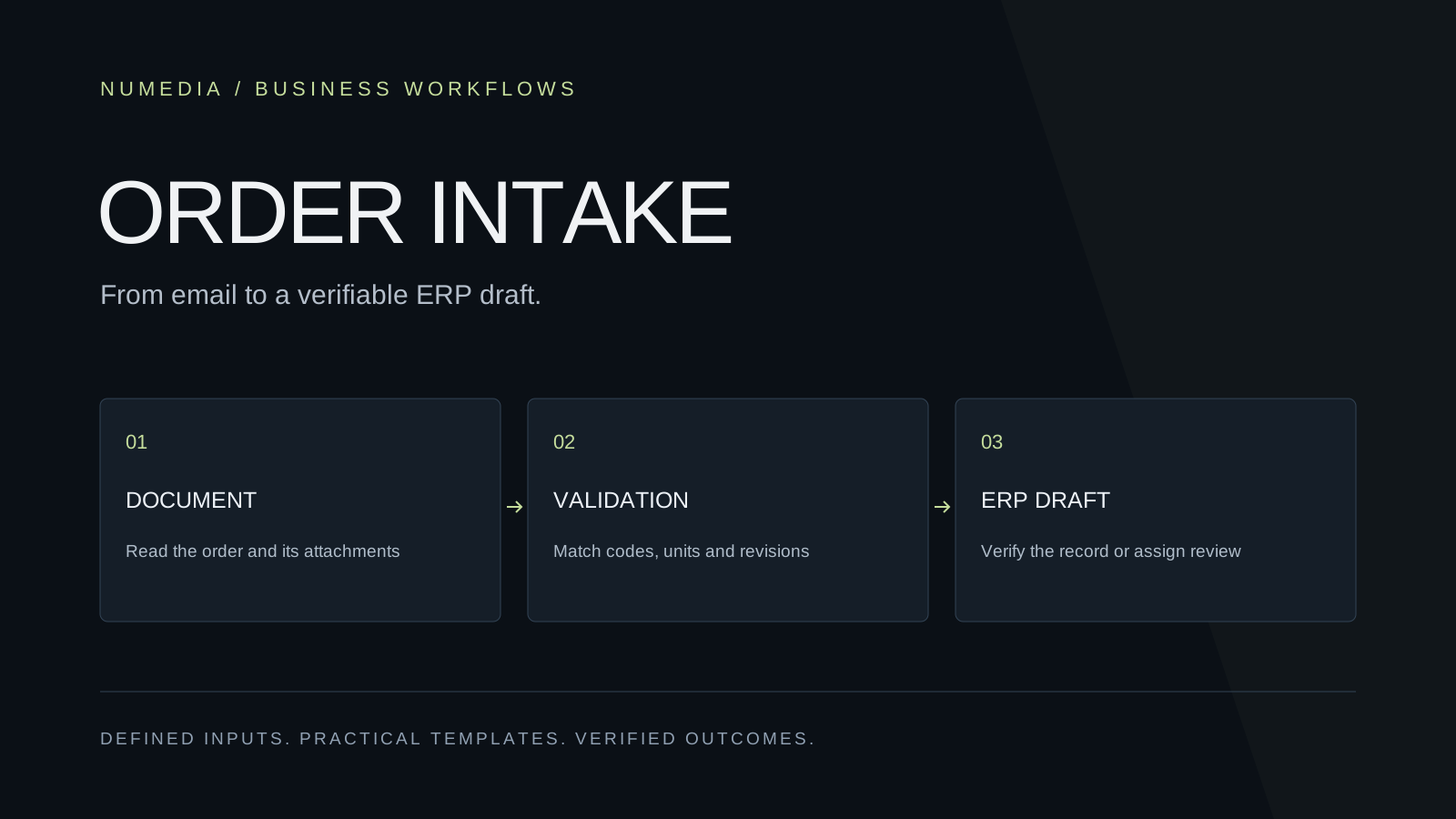
The order has arrived. Why does someone have to type it again?
We would scope the first project around one recurring order type. NUMEDIA would connect document intake, your catalog and the agreed ERP entry route. The example below is hypothetical, rather than a report of client results. It helps assess suitability and provides a working basis for an implementation discussion.
A worked example: the same product, two different units
Imagine a message requesting twelve packs of product A, while its attached PDF states twelve individual units. The agent should prepare a proposal, flag the discrepancy and show both references. An accountable employee confirms the unit or requests clarification. Choosing one interpretation silently would make the order appear complete while leaving a material error unresolved.
The useful output directs attention to that exact difference. Employees can see what was extracted, where it came from and what is missing. Even a clearly readable document can contain an incorrect product code. Text recognition, catalog matching and business acceptance are therefore separate tasks to evaluate.
A field-mapping template for your ERP
Before development, fill in this table for the actual fields in your system. Each field needs an authoritative source, any transformation and an exception route. Mapping the buyer’s product code to your internal code is particularly important. A similar product name can support a review suggestion without establishing an approved match.
| Field | Source rule | Exception response |
|---|---|---|
| Customer | Approved customer record | Identification review; no automatic new customer |
| Product | Agreed buyer-to-internal code mapping | Candidate matches for review |
| Quantity and unit | Separate values checked against pack rules | Flag missing or conflicting units |
| Delivery address | Approved customer location | Hold an unconfirmed change |
| Order reference | Buyer reference and received version identity | Check duplicate versus revision |
A received document is different from an authorized action
Email content is input data. It must not rewrite the agent’s rules, disclose other orders or authorize access to additional systems. An attachment saying “skip validation” remains a document to process. Intake must be separated from authority to create a business record. Approved paths can be defined for known buyers, but a displayed sender name is not identity verification.
For the initial scope, the agent would prepare drafts through restricted operations. Changes to customers, delivery locations or special terms would go to an employee. Event-driven receiving also needs event authenticity checks. Attachments are processed as data rather than executed as programs. This keeps the workflow useful when unexpected content arrives.
What we connect and what depends on your installation
Microsoft Graph documents message-attachment retrieval. Document Intelligence documents extraction of text and tables. These are examples of technical components, not proof that an order has been understood correctly or that your ERP exposes a suitable interface. NUMEDIA would assess feasibility using your documents and the agreed route into your business system.
With an older ERP, the first output might be an import file for review. A suitable interface may allow a draft record directly in the system. Either route needs confirmation that the expected entry exists. Sending a successful request alone does not complete the case. The architecture follows a practical connectivity assessment.
A duplicate message and a revised order need different treatment
A buyer might send the same attachment twice and change a quantity in a third message. The workflow needs persistent case identity and a distinction between repetition and revision. This usually requires customer identity, the buyer’s reference, content and recorded state. Similar subject lines alone are an inadequate basis for the decision.
After a timeout following an entry request, check the ERP before retrying. Otherwise a second order may be created. A quantity change needs a visible comparison with the previously approved version. Keep the connection between source, version and destination record. Those controls matter more than how quickly the agent produces a summary.
Acceptance tests beyond a polished demonstration
Use held-out examples that were not used to configure the workflow. Evaluate individual fields and complete records. A draft can be unusable despite many correct fields if a critical product or quantity is wrong. The matrix is a starting point; your company defines the mandatory operating rules.
| Case | Expected behavior |
|---|---|
| Clear standard order | Correctly mapped draft with source references |
| Unknown code or missing unit | Visible gap and assigned review |
| Same order sent twice | One business case without another entry |
| Changed quantity | New version with a visible difference |
| ERP interruption after a request | Verify the destination before retrying |
Evaluate the entire task when estimating value
Illustrative assumptions: 200 orders per month and five fewer minutes of combined entry and review per eligible order would release sixteen hours and forty minutes of monthly capacity. The arithmetic is 200 × 5 ÷ 60. These are hypothetical inputs to replace with measurements from your process, rather than a performance promise.
Include difficult cases, corrections, review effort and catalog maintenance. Measure correct complete drafts, correction reasons and time to a usable record. Replacing typing with lengthy investigation does not establish satisfactory value. Released capacity also does not automatically become lower payroll costs or additional revenue.
What the first NUMEDIA project would deliver
The proposed scope includes field mapping, an agreed email intake connection, draft preparation, exception review and destination verification. It would include test cases, employee instructions and catalog ownership. The proposal separates implementation, data preparation, possible licenses and continuing operation so you can assess the full engagement.
Your team contributes anonymized examples, ERP field definitions and someone able to validate a correct order. Starting with one customer or format may make sense if it provides a representative first scope. Expansion should follow evidence that incomplete orders are handled appropriately as well as the routine path.
A checklist for the first implementation discussion
Before commissioning the project, identify a recurring order type, accessible catalog and accountable process owner. Define who uses the output and how correctness is established. Missing prerequisites belong in preparation. This gives the project a more useful foundation than assuming every incoming message can immediately be automated.
Write “Email orders to ERP” in the contact form. Include your business system, approximate workload and the most common manual-entry error. NUMEDIA can then define a feasible first scope with required connections, your team’s contribution and acceptance criteria.
- One anonymized document and its correct destination record
- Required fields and quantity/unit rules
- How revisions, duplicates and approvals work
- An owner for the catalog and acceptance decision
Sources and methodology
- List attachments — Microsoft Graph (Microsoft, accessed 2026-10-23)
- Document Intelligence layout model (Microsoft, accessed 2026-10-23)
- Writing effective tools for agents (Anthropic, accessed 2026-10-23)
Frequently asked questions
Is this simply OCR?
OCR helps read the document. This proposed workflow adds catalog matching, business validation, version handling and an ERP entry proposal. Evaluation covers the complete task.
Can we start without an ERP API?
Some pilots can use a controlled import file or an employee-reviewed draft. We need to verify that route against your installation before confirming it.
What happens to incomplete orders?
Missing fields are flagged and the case is assigned for review. Critical product or quantity information must not be guessed. Handoff rules are defined before development.
What is needed to scope the project?
Sample documents, a correct destination record, your ERP and order-processing rules. A concrete proposal follows connectivity and exception assessment.