AI business workflows · 8 min read
AI sales meeting preparation: a brief your team can actually use
Minutes before a meeting, a salesperson opens old notes, searches for the latest proposal and checks what the customer already said. When this happens repeatedly, preparation is a concrete use case for an AI agent. Its output would be a short brief containing facts, sources, open questions and a proposed meeting objective that the salesperson can verify.
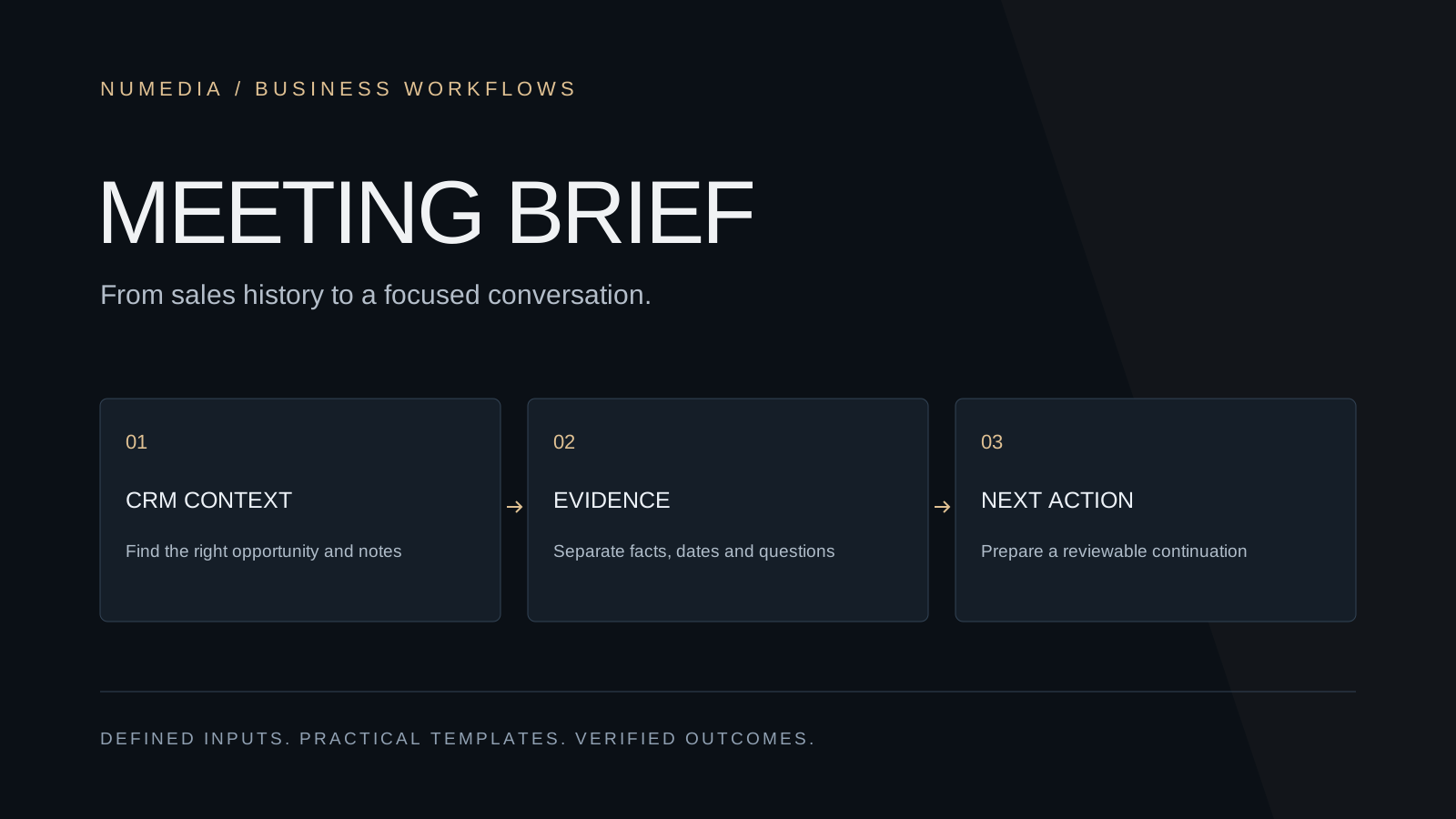
Salespeople need context before the conversation
NUMEDIA would begin with your current preparation process and one meeting type. The hypothetical example below follows a B2B company continuing a discussion about a new solution. It is not a report of client outcomes. It demonstrates a practical design and ways to evaluate the brief before introducing the workflow into daily use.
Choose a specific meeting type
An initial discovery call, proposal discussion and existing-client review require different preparation. Discovery examines the problem and objective. A proposal discussion identifies unresolved buying questions. A client review checks agreed next steps. One long generic template could hide the distinctions that matter.
For the first scope, choose a repeatable meeting with accessible notes. Define the trigger, associated opportunity and recipient. A company name in a calendar entry may not be enough to identify the correct deal. If matching is ambiguous, the agent should request a selection rather than merge context from different opportunities.
A brief template: fact, significance and question
A useful brief separates what is known from what should be checked. Facts carry a source reference and date. Interpretation remains a proposed discussion point. The salesperson can distinguish an established statement from an assumption. This working template is NUMEDIA’s proposed structure, to be adapted to your team.
| Section | Example content | Salesperson checks |
|---|---|---|
| Meeting objective | Agree the scope of a first project | Whether this remains the objective |
| Confirmed facts | Customer described manual transfer between two systems | Source and date |
| Open questions | Who validates integration feasibility | Whether that person joins the discussion |
| Earlier next action | Customer was to provide a process example | Whether it actually arrived |
| Proposed conclusion | Assign an owner and the next verification | Whether it fits the conversation |
A worked example: an old note is not a current fact
A CRM note says the customer previously planned to replace a system. The brief should identify its date and mark the plan for confirmation. It must not turn that into “the customer is replacing its ERP now.” A better question is whether the replacement plan still applies and what that means for the first project.
A proposed decision date may also have passed. The brief should surface the difference between a recorded plan and current opportunity status. Conflicting notes should remain visible rather than be smoothed into a persuasive story. The useful outcome is fewer overlooked questions. Polished writing without that discipline could prepare the salesperson for the wrong conversation.
Connect the sources your preparation actually needs
The basic workflow would connect a calendar event with approved CRM notes and tasks. Microsoft Graph documents event retrieval. HubSpot documents CRM notes and tasks. These illustrate technical foundations rather than confirm access or readiness in your specific account.
NUMEDIA would check the mapping between event, company, opportunity and account owner. Only sources required for the agreed purpose belong in the preparation. Any public company information added later needs its own source and freshness check. Organized internal sales history may offer a more useful initial pilot than broad collection of unrelated information.
Build questions from gaps in this opportunity
Generic questions about challenges and budget do not require a special agent. Value appears when a question connects to what the buyer already said. If manual work has been mentioned without a workload figure, ask how many cases the team handles and who validates a correct result. Unconfirmed system access represents a different implementation gap.
We would prioritize questions against the meeting objective. Put questions needed to establish the next step first. The brief should not repeat a question whose answer is already clearly recorded. The salesperson chooses and adapts questions during the conversation. The agent prepares context; it does not replace judgment about the customer relationship.
Turn confirmed meeting notes into useful follow-up
A meeting needs an actionable continuation. After a salesperson confirms notes, the agent could draft a task identifying an owner, output and agreed deadline. Any follow-up message should reflect the actual meeting record. The pre-meeting plan is not evidence that a customer accepted its proposed outcome.
In the initial scope, drafts would be reviewed before recording or sending. If task creation fails ambiguously, check the CRM before retrying so a connection interruption does not create duplicate tasks. The route from preparation to a confirmed next action remains traceable and useful for the following conversation.
Quality criteria the brief should pass
Experienced salespeople would assess selected cases for factual accuracy, freshness, question usefulness and correction effort. The brief must not invent a decision, person or commitment. Such an error warrants correcting the process even if the rest of the writing is fluent.
| Criterion | Review question |
|---|---|
| Correct opportunity | Do all notes relate to this deal |
| Verifiable facts | Does the statement have a source and date |
| Visible gaps | Is missing information identified |
| Useful questions | Does the question support the meeting objective |
| Actionable continuation | Does the proposal have an output, owner and basis in agreement |
Estimate value without promising sales uplift
Illustrative assumptions: five salespeople each attend eight eligible meetings weekly. Six fewer minutes of combined preparation and review per meeting would release four hours of weekly capacity. The calculation is 5 × 8 × 6 ÷ 60. These are hypothetical inputs, not measured NUMEDIA outcomes. Your pilot would test whether such a difference occurs.
Also monitor meetings with an explicit continuation and the quality of CRM updates. Increased sales cannot automatically be attributed to the agent: opportunities, the offer and salesperson performance also influence results. Initial value may be less preparatory searching and more consistent follow-through. Comparisons should account for meeting type and complexity.
A first implementation with NUMEDIA
The proposed scope covers one meeting type, calendar and CRM connections, a brief template and next-task drafts. It would include a test set, stale-information rules and salesperson instructions. Your contribution is examples of good preparation, approved sources and someone able to validate commercial usefulness.
Write “AI sales meeting preparation” in the contact form. Describe what people currently search for before a conversation, and name your CRM, calendar and meeting type. NUMEDIA can then define a practical first workflow with clear scope and acceptance criteria. You can assess what the team would receive before committing to broader automation.
- One meeting type with an explicit objective
- An accepted brief and confirmed-note examples
- Rules linking an event to the correct opportunity
- Accuracy, freshness and usefulness criteria
Sources and methodology
- Get event — Microsoft Graph (Microsoft, accessed 2026-10-23)
- Activities | Notes (HubSpot, accessed 2026-10-23)
- Activities | Tasks (HubSpot, accessed 2026-10-23)
Frequently asked questions
Does the agent need to record meetings?
No. This initial proposal uses calendar events and approved CRM notes and tasks. Any additional meeting capture would need its own defined scope.
Do we need a fully organized CRM?
The selected use case needs sufficiently reliable records. Missing information and unlinked opportunities can be addressed in preparation rather than assumed away.
Will it send follow-up messages automatically?
We propose salesperson-reviewed drafts first. Messages must reflect actual agreements, not just the objective planned before the conversation.
How do we avoid generic briefs?
Tie preparation to the meeting objective and specific opportunity. Significant questions should arise from a demonstrable gap or next action in that deal.