AI implementation in practice · 8 min read
AI order support: what implementation would look like in your store
“Where is my order?” is a short question. Answering it often means opening the store, checking payment, reviewing fulfillment and finding a tracking link. If these messages fill your queue, this is a practical place to begin with AI. NUMEDIA would design an agent that retrieves relevant information for an authorized request and prepares a useful response with a clear next step.
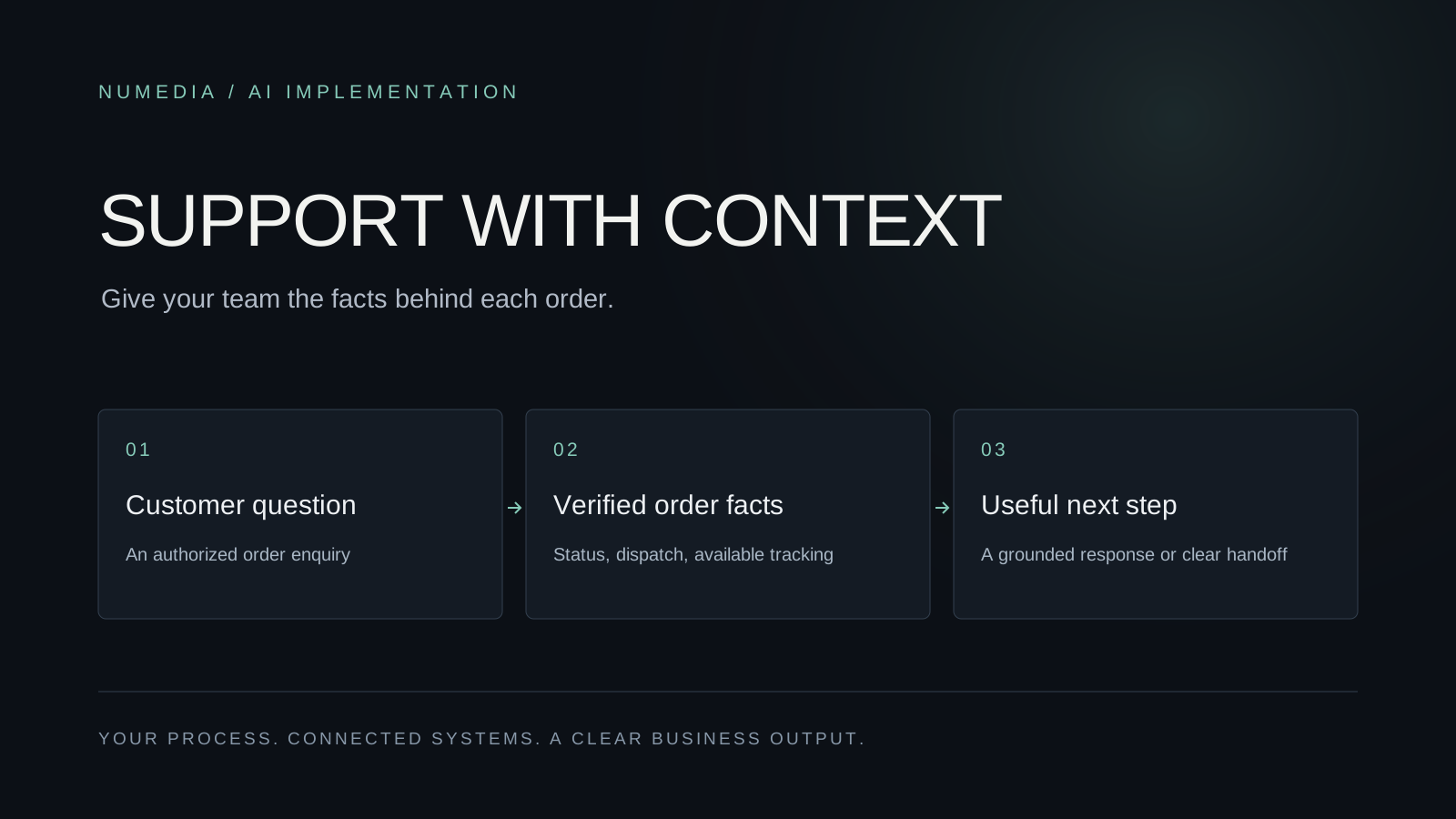
Your support team should not have to find the same information every day
The example below describes a hypothetical store selling physical products. It is an implementation proposal, not a claim about client savings. The first project would reduce repetitive work while preserving the quality of service. You would receive a defined solution for one request type that can be tested against real cases.
What would happen when a customer asks about an order
A customer asks about an order through a verified customer environment. The system checks their entitlement to that order’s information and retrieves its current state. The agent explains what is confirmed, whether dispatch has occurred and which tracking link is available. If the case is unclear, it prepares a support task with a summary of the checks already completed.
An order marked fulfilled does not by itself prove delivery. The agent must distinguish store information from a carrier’s confirmed status. If the latter is unavailable, it must remain unavailable in the answer. The customer gets a clear explanation, and the employee can see which source was checked. They can continue without rebuilding the entire case history.
Choose one request type for the first project
Rather than automate the entire support department, we would begin with order status and dispatch questions. Together, we review a sample of messages and define which requests qualify. Product changes, unusual complaints and refund requests can follow a route to an employee. The customer remains in the same process while the responsible handler changes.
We make the scope testable: supported languages, channels, order states and response rules. We also define when the agent should stop drafting and hand over. A useful initial project has repeatable inputs and an output someone can verify. Further request types should follow support experience rather than the appeal of a long feature list.
Connect order information, delivery and service rules
Your store would supply order records. Connected logistics tools could provide additional dispatch information where access is feasible. Shopify documents the Order object, and WooCommerce documents its REST API for external connections. These show possible integration routes; available fields and access still need to be checked in your installation.
Separately, we would organize approved instructions: how statuses are explained, when a delay is investigated and who handles exceptional cases. Instructions cannot replace the current state of an order. NUMEDIA would combine your service rules with live data retrieval in one workflow. Each connection would include a defined response to a temporarily unavailable source.
How work would be shared with your support team
When an employee takes over, they need the request, completed checks and reason for escalation. Customers should not have to describe the issue again. The table outlines a proposed allocation for the first scope. We would adapt it to your products, delivery arrangements and service process.
| Case | System response | Team responsibility |
|---|---|---|
| Tracking link available | Drafts an answer using verified information | Reviews a sample of completed cases |
| No recent shipping information | States the last confirmed status | Investigates with logistics |
| Customer requests a change | Summarizes the request and creates a task | Decides whether the change is possible |
| Source unavailable | Records the obstacle and preserves the case | Continues after access is restored |
Make handoffs useful rather than another queue
An incomplete handoff creates more work. Each exit therefore needs an owner and a meaningful state: waiting for the customer, waiting for logistics or awaiting a support decision. The agent should not close a case simply because it generated text. Completion means an appropriately resolved request or an accepted handoff.
Anthropic’s tool guidance emphasizes clear purpose and meaningful results. In this implementation, a lookup should identify which order was read and which information is available. The employee receives enough evidence to act. Reading an order and changing it would be treated as distinct capabilities, with separate conditions for introducing each into the agreed workflow.
What you would receive in a scoped project
The proposed work covers request analysis, an agreed order-data connection, response rules, exception routing and an environment for review. If your team already uses a suitable support tool, we assess how the workflow could fit into it. The result needs to work for the people serving customers, beyond a demonstration of one successful conversation.
The project would include tests across different order states and instructions for maintaining responses. Handover would demonstrate missing data and repeated requests as well as the normal path. The proposal defines channels, languages, integration scope, model usage and continuing support. That gives you a concrete basis for comparing the implementation with your current operation.
What your team would contribute
We need someone familiar with orders who can validate the right response for typical situations. Anonymized messages, a list of order states and the delay-investigation process are useful inputs. Your team defines customer commitments and the situations requiring individual treatment. NUMEDIA turns these into an implementable workflow and testable acceptance criteria.
You do not need to rewrite your entire knowledge base first. We organize the information required for the selected request type and assign responsibility for changes. When dispatch arrangements change, someone needs to update the instructions. The project therefore includes maintenance ownership. Answer quality depends on the quality of available information throughout operation, not only on launch day.
Measure capacity alongside service quality
Illustrative example: 300 eligible enquiries per month with four fewer minutes of manual lookup would release twenty hours of capacity. The calculation, 300 × 4 ÷ 60, is not a performance promise. Your pilot must also measure review time, corrections and work on escalated cases before the comparison becomes useful.
We would examine answer correctness, reopened requests and successful handoffs. A faster answer that makes the customer write again is not a satisfactory outcome. Nor is a high automation rate sufficient by itself. What matters is appropriately handled cases and the team’s total handling time. Customer satisfaction can also be compared over a longer observation period.
How the implementation would enter daily use
First compare drafts with experienced support decisions on historical cases. Then introduce the workflow into a limited part of daily work with a defined review process. Any automatic answering scope follows agreed criteria and your operating rules. Acceptance conditions are established before development, so the project is judged on more than whether an answer sounds convincing.
Before rollout, we also establish who monitors failed connections and where new requests go during an interruption. The team must be able to continue without the automation. After the first scope performs well, we can assess further languages or request types. Each addition gets a specific purpose and its own testable outcome.
Show us the questions your customers keep asking
Write “AI order support” in the contact form, name your store platform and estimate the volume of these questions. Describe where an employee currently finds the answer. This gives us a basis for identifying a feasible pilot and the connections it needs. A clear description of the problem is enough for the first discussion.
NUMEDIA would scope the request types covered, what support employees receive and how quality is measured. You can then see what you are buying and which work remains with your team. Price and timing follow an assessment of your actual systems and the agreed implementation scope.
Sources and methodology
- Writing effective tools for agents (Anthropic, accessed 2026-10-22)
- Order — GraphQL Admin API (Shopify, accessed 2026-10-22)
- WooCommerce REST API (WooCommerce, accessed 2026-10-22)
Frequently asked questions
Can this work with Shopify or WooCommerce?
Both platforms document external integration routes. We assess your installation, available fields and logistics connections before confirming the proposed workflow.
Will the agent issue refunds or change orders?
This initial proposal covers status retrieval and response preparation. It routes change and refund requests to an accountable employee. Further actions require a separately defined scope and operating rules.
Can we start without an organized knowledge base?
We first prepare the rules for the selected question type and validate them with support. The initial scope does not need to cover every product and possible situation.
How do we know the implementation is worthwhile?
The pilot should demonstrate suitable answers, useful handoffs and less total manual work across comparable cases. We agree those criteria before development begins.